Malala Yousafzai : Diary of a Pakistani schoolgirl

Private schools in Pakistan's troubled north-western Swat district have been ordered to close in a Taleban edict banning girls' education. Militants seeking to impose their austere interpretation of Sharia law have destroyed about 150 schools in the past year. Five more were blown up despite a government pledge to safeguard education, it was reported on Monday. Here a seventh grade schoolgirl from Swat chronicles how the ban has affected her and her classmates. The diary first appeared on BBC Urdu online.
THURSDAY JANUARY 15: NIGHT FILLED WITH ARTILLERY FIRE
The night was filled with the noise of artillery fire and I woke up three times. But since there was no school I got up later at 10 am. Afterwards, my friend came over and we discussed our homework. Today is 15 January, the last day before the Taleban's edict comes into effect, and my friend was discussing homework as if nothing out of the ordinary had happened. Today, I also read the diary written for the BBC (in Urdu) and published in the newspaper. My mother liked my pen name 'Gul Makai' and said to my father 'why not change her name to Gul Makai?' I also like the name because my real name means 'grief stricken'. My father said that some days ago someone brought the printout of this diary saying how wonderful it was. My father said that he smiled but could not even say that it was written by his daughter.
WEDNESDAY 14 JANUARY: I MAY NOT GO TO SCHOOL AGAIN
I was in a bad mood while going to school because winter vacations are starting from tomorrow. The principal announced the vacations but did not mention the date the school was to reopen. This was the first time this has happened. In the past the reopening date was always announced clearly. The principal did not inform us about the reason behind not announcing the school reopening, but my guess was that the Taleban had announced a ban on girls' education from 15 January. This time round, the girls were not too excited about vacations because they knew if the Taleban implemented their edict they would not be able to come to school again. Some girls were optimistic that the schools would reopen in February but others said that their parents had decided to shift from Swat and go to other cities for the sake of their education.
Since today was the last day of our school, we decided to play in the playground a bit longer. I am of the view that the school will one day reopen but while leaving I looked at the building as if I would not come here again.
FRIDAY 9 JANUARY: THE MAULANA GOES ON LEAVE?
Today at school I told my friends about my trip to Bunair. They said that they were sick and tired of hearing the Bunair story. We discussed the rumours about the death of Maulana Shah Dauran, who used to give speeches on FM radio. He was the one who announced the ban on girls attending school. Some girls said that he was dead but others disagreed. The rumours of his death are circulating because he did not deliver a speech the night before on FM radio. One girl said that he had gone on leave. Since there was no tuition on Friday, I played the whole afternoon. I switched on the TV in the evening and heard about the blasts in Lahore. I said to myself 'why do these blasts keep happening in Pakistan?'
WEDNESDAY 7 JANUARY: NO FIRING OR FEAR
I have come to Bunair to spend Muharram (a Muslim holiday) on vacation. I adore Bunair because of its mountains and lush green fields. My Swat is also very beautiful but there is no peace. But in Bunair there is peace and tranquillity. Neither is there any firing nor any fear. We all are very happy. Today we went to Pir Baba mausoleum and there were lots of people there. People are here to pray while we are here for an excursion. There are shops selling bangles, ear rings, lockets and other artificial jewellery. I thought of buying something but nothing impressed - my mother bought ear rings and bangles.
MONDAY 5 JANUARY: DO NOT WEAR COLOURFUL DRESSES
I was getting ready for school and about to wear my uniform when I remembered that our principal had told us not to wear uniforms - and come to school wearing normal clothes instead. So I decided to wear my favourite pink dress. Other girls in school were also wearing colourful dresses and the school presented a homely look.My friend came to me and said, 'for God's sake, answer me honestly, is our school going to be attacked by the Taleban?' During the morning assembly we were told not to wear colourful clothes as the Taleban would object to it. I came back from school and had tuition sessions after lunch. In the evening I switched on the TV and heard that curfew had been lifted from Shakardra after 15 days. I was happy to hear that because our English teacher lived in the area and she might be coming to school now.
SUNDAY 4 JANUARY: I HAVE TO GO TO SCHOOL
Today is a holiday and I woke up late, around 10 am. I heard my father talking about another three bodies lying at Green Chowk (crossing). I felt bad on hearing this news. Before the launch of the military operation we all used to go to Marghazar, Fiza Ghat and Kanju for picnics on Sundays. But now the situation is such that we have not been out on picnic for over a year and a half. We also used to go for a walk after dinner but now we are back home before sunset. Today I did some household chores, my homework and played with my brother. But my heart was beating fast - as I have to go to school tomorrow.
SATURDAY 3 JANUARY: I AM AFRAID
I had a terrible dream yesterday with military helicopters and the Taleban. I have had such dreams since the launch of the military operation in Swat. My mother made me breakfast and I went off to school. I was afraid going to school because the Taleban had issued an edict banning all girls from attending schools. Only 11 students attended the class out of 27. The number decreased because of Taleban's edict. My three friends have shifted to Peshawar, Lahore and Rawalpindi with their families after this edict. On my way from school to home I heard a man saying 'I will kill you'. I hastened my pace and after a while I looked back if the man was still coming behind me. But to my utter relief he was talking on his mobile and must have been threatening someone else over the phone.

Malala Yousafzai:‘Gulmakai’ the future of Pakistan

“The only way to power is politics, and the only way to politics is education,” repeated the girl from Mingora, Swat who was among thousands of others whose lives were threatened by the Taliban in 2009, merely for seeking education. Today, Malala Yousafzai
is a beacon of hope for thousands of other girls who dare to dream of education and ambition. At the 8th International Conference on Women Leadership held in Islamabad last week, Yousafzai was given the excellence award in the category of “The Future of Pakistan”. “I could not believe when I heard them calling me the future of Pakistan. I am highly encouraged by this award. I need appreciation and encouragement to complete a long and tough journey that is ahead,” she said upon receiving the award. The world looked at the miseries of Swat through this beautiful pair of eyes, and realised the pain through the words that came out of her which she penned under the name of ‘Gulmakai’. The innocence in her writing represented those bereavements which many adults were unable to describe. Gulmakai’s diary was first published on BBC Urdu’s website in 2009. Aged 15, Malala is now studying in the 9th grade. “Swat is peaceful now. But I don’t understand the fact that why the government is not showing any interest in rehabilitating the people who suffered the displacement. They are not even building the schools for us. It’s just the Pakistan Army with the cooperation of UAE government, which is helping recover Swat from the horrific aftermath of Talibanisation,” she exclaims with a mix of sorrow and anger. Accompanying Yousafzai at the conference, her parents believe that their daughter has a long way to go. “Death is inevitable. Every person has to die at some point, whether there is terrorism or not. This does not mean that we should stop walking on the path of truth. My husband and my daughter both have proven that no terror can hinder the way of truth. She is making us proud since the day she was born,” her mother states. Forty-three year old Ziauddin is the proud father of Yousafzai, who heads the Khushal Khan School and College in Swat (for boys and girls). He was the spokesman of the National Jirga in Swat at the time of Talibanisation when Abdul Hai Kakar, then a correspondent of BBC, reached out to him and asked him to find a female teacher in Swat who could write about the cruelties of Taliban. To his disappointment no one agreed to do so. “My only daughter, Malala was just 11 years of age when I first asked her to write about Swat and the Talibanisation in 2008. She did it. Not for the sake of her father’s wish, but for the sake of the safety and peace of her land. No one was willing to write the inside stories, the cruelty, the terror and the sufferings of the people of Swat because of the life threats by Taliban. She used the pseudonym, and I remember the first time I saw someone print the diary, I could not tell them that it’s my daughter who has written this. Today, I am happy that the world knows who Gulmakai is!” Yousafzai’s ambition doesn’t end with obtaining education. She wants to be a politician when she grows up. “Democracy is the best rule. This country needs new leaders. I want to study the law and I dream of a country in which education prevails and no one sleeps hungry. That would be my kind of country.” The conviction in her voice, truly matches the title awarded to her. One can see her sparkling eyes witnessing the bright future of Pakistan.

Pakistan: ''Lessons in judicial restraint''

Source:THE HINDU
BY:MARKANDEY KATJU
In a democracy, the remedy for a malfunctioning legislature and executive must come from the people, not the judiciary It is evident that the Pakistan Supreme Court has embarked on a perilous path of confrontation with the political authorities, which can only have disastrous consequences for the country. Recently its Chief Justice said that the Constitution, not Parliament, is supreme. This is undoubtedly settled law since the historical decision of the U.S. Supreme Court in Marbury vs. Madison (1803). The grave problem, however, that courts are often faced with is this: on the one hand, the Constitution is the supreme law of the land and, on the other hand, in the garb of interpreting the Constitution, the court must not seek an unnecessary confrontation with the legislature, particularly since the legislature consists of representatives democratically elected by the people. The solution was provided in the classical essay “The Origin and Scope of the American Doctrine of Constitutional Law” published in 1893 in the Harvard Law Review by James Bradley Thayer, Professor of Law at Harvard University. It elaborately discusses the doctrine of judicial restraint. Justices Holmes, Brandeis, and Frankfurter of the U.S. Supreme Court were followers of Prof. Thayer’s philosophy of judicial restraint. Justice Frankfurter referred to Thayer as “the great master of Constitutional Law,” and in a lecture at the Harvard Law School said: “If I were to name one piece of writing on American Constitutional Law, I would pick Thayer's once famous essay, because it is a great guide for judges, and therefore the great guide for understanding by non-judges of what the place of the judiciary is in relation to constitutional questions.” The court certainly has power to decide constitutional issues. However, as pointed out by Justice Frankfurter in West Virginia State Board of Education vs. Barnette 319 U.S. 624 (1943), since this great power can prevent the full play of the democratic process, it is vital that it should be exercised with rigorous self restraint. SEPARATION OF POWERS: The philosophy behind the doctrine of judicial restraint is that there is broad separation of powers under the Constitution, and the three organs of the State, the legislature, the executive, and the judiciary, must respect each other, and must not ordinarily encroach into each other's domain, otherwise the system cannot function properly. Also, the judiciary must realise that the legislature is a democratically elected body, which expresses the will of the people (however imperfectly) and in a democracy this will is not to be lightly frustrated or thwarted. Apart from the above, as pointed out by Prof. Thayer, judicial over-activism deprives the people of “the political experience and the moral education and stimulus that comes from fighting the problems in the ordinary way, and correcting their own errors”. In Asif Hameed vs. The State of J&K, AIR 1989 S.C. 1899 (paragraphs 17 to 19), the Indian Supreme Court observed: “Although the doctrine of separation of powers has not been recognised under the Constitution in its absolute rigidity, the Constitution makers have meticulously defined the functions of various organs of the State. The legislature, executive, and judiciary have to function within their own spheres demarcated in the Constitution. No organ can usurp the function of another. -- While exercise of powers by the legislature and executive is subject to judicial restraint, the only check on our own exercise of power is the self imposed discipline of judicial restraint.” Judicial restraint is particularly important for the Supreme Court for two reasons: (1) Of the three organs of the state, only one, the judiciary, is empowered to declare the limits of jurisdiction of all three organs. This great power must therefore be exercised by the judiciary with the utmost humility and self restraint. (2) The errors of the lower courts can be corrected by the higher courts, but there is none above the Supreme Court to correct its errors. Some people justify judicial activism by saying that the legislature and executive are not properly performing their functions. The reply to this argument is that the same charge is often levelled against the judiciary. Should the legislature or the executive then take over judicial functions? If the legislature and the executive do not perform their functions properly, it is for the people to correct them by exercising their franchise properly, or by peaceful and lawful public meetings and demonstrations, and/or by public criticism through the media and by other lawful means. The remedy is not in the judiciary taking over these functions, because the judiciary has neither the expertise nor the resources to perform these functions. In this connection I may quote from an article by Wallace Mendelson published in 31 Vanderbilt Law Review 71 (1978): “If, then, the Thayer tradition of judicial modesty is outmoded, if judicial aggression is to be the rule, as in the 1930s, some basic issues remain: “First, how legitimate is government by Judges? Is anything beyond their reach? Will anything be left for ultimate resolution by the democratic process, for, what Thayer called ‘that wide margin of considerations which address themselves only to the practical judgment of a legislative body representing (as Courts do not) a wide range of mundane needs and aspirations?’ “Second, if the Supreme Court is to be the ultimate policy making body without accountability, how is it to avoid the corrupting effects of raw power? Also, can the Court satisfy the expectations it has aroused? “Third, can nine men [the Supreme Court Judges] master the complexities of every phase of American life? Are any nine men wise enough and good enough to wield such power over the lives of millions? Are Courts institutionally equipped for such burdens? Unlike legislatures, they are not representative bodies reflecting a wide range of social interest. Lacking a professional staff of trained investigators, they must rely for data almost exclusively upon the partisan advocates who appear before them. Inadequate or misleading information invites unsound decisions. “Finally, what kind of citizens will such a system of judicial activism produce, a system that trains us to look not to ourselves for the solution of our problems, but to the most elite among elites: nine Judges governing our lives without political or judicial accountability? Surely this is neither democracy nor the rule of law.” In Marbury vs. Madison (1803), Chief Justice Marshal, while avoiding confrontation with the government of President Jefferson, upheld the supremacy of the Constitution. Another example is the very recent judgment of U.S. Chief Justice John Roberts in the Affordable Healthcare Act case, in which he basically followed the doctrine of judicial restraint. In Divisional Manager, Aravali Golf Course vs. Chander Haas (2006) the Indian Supreme Court observed: “Judges must know their limits and not try to run the government. They must have modesty and humility and not behave like Emperors. There is broad separation of powers under the Constitution, and each of the organs of the state must have respect for the others and must not encroach into each other’s domain.” A similar view was taken in Government of Andhra Pradesh vs. P. Laxmi Devi. NEW DEAL LEGISLATION: A reference may usefully be made to the well known episode in the history of the U.S. Supreme Court when it dealt with the New Deal legislation initiated by President Franklin Roosevelt soon after he assumed office in 1933. When the overactive court kept striking down this legislation, President Roosevelt proposed to pack the court with six of his nominees. The threat was enough, and it was not necessary to carry it out. In 1937, the court changed its confrontationist attitude and started upholding the legislation (see West Coast Hotel Vs. Parrish). “Economic due process” met with a sudden demise. The moral of this story is that if the judiciary does not maintain restraint and crosses its limits there will be a reaction which may do great damage to the judiciary, its independence, and its respect in society. It is not my opinion that a judge should never be activist, but such activism should be done only in exceptional and rare cases, and ordinarily judges should exercise self restraint. In Dennis vs. U.S. (1950), Justice Frankfurter observed: “Courts are not representative bodies. They are not designed to be a good reflex of a democratic society. Their essential quality is detachment, founded on independence. History teaches that the independence of the judiciary is jeopardised when Courts become embroiled in the passions of the day, and assume primary responsibility in choosing between competing political, economic, and social pressures”. The Pakistan Supreme Court would be well advised to heed these words of wisdom, even at such a late stage. (Justice Markandey Katju is chairman of the Press Council of India.)

DRONES ARE 'LIFE SAVERS' STUPID...!!!

BY: Mwaqar
Drama Queen of Pakistani politics, Imran Talib Fake Khan is going to stage a new drama,this time he is going to demonstrate against unmanned predators conducting airstrikes in Pakistan.Drama Queen is going to lead a 100,000-strong rally from various parts of the world to Waziristan in its protest against remotely-controlled airstrikes in Pakistan’s tribal region,this is a wrong choice and will endanger many people, but In Pakistan, Politicians don't think about the consequences.Although I am sure that Imran Talib Fake Khan and his top party men would be getting fool proof protection from all militant groups including Al Qaida who are stationed in NWA.I am not sure whether this (mis)adventure would translate into more votes for PTI,but one wonders who is sponsoring this march…your guess is as good as mine, desperate Khan, I bet won’t be able to stop the Drones, but just another political gimmick to get his vote bank stronger. Unfortunately Pakistanis are very Simple,they can be fooled by these idiots easily,it will be just another political stunt by imran fake khan and his jihadi buddies sponsored by their big bosses in the GHQ.Majority of locals in Waziristan support the attacks and see the drones as their ‘liberators’ from the clutches of Taliban and Pakistan’s Intelligence agencies. The people of Waziristan are suffering a brutal kind of occupation under the Taliban and al Qaeda. It is in this context that they would welcome anyone, Americans, Israelis, Indians or even the devil, to rid them of the Taliban and al Qaeda.We need to wake up to the reality that the enemy has grown very strong in the years we temporized and tried to do deals with them. Clearly, we need allies in this fight. Howling at the moon is not going to get us the cooperation we so desperately need. A solid case can be made for more drone attacks, not less.Most people in FATA think, the drone attacks were accurate and did not lead to anti-American sentiment and were effective in damaging the militants. In addition the locals wanted the Pakistani forces to also target the militants but the problem is the Pakistani forces play double game and don’t target many jihadi groups who are on ISI payroll, locals usually appreciate drone attacks when they compare it with the Pakistan Army’s attacks.So instead of protesting against life savers,pro-taliban Imran fake khan should protest against his buddies in the ranks of Taliban,Opposition to American policies in the region does not mean, however, that the people of FATA embrace either Al-Qaeda or the Taliban. More than three-quarters of FATA residents oppose the presence inside their region of Al-Qaeda and over two-thirds the Pakistan Taliban (60 percent oppose the Afghan Taliban led by Mullah Omar).But the problem is,Pakistani Govt does not have any writ in those areas,Pakistani security forces are living in denial and not taking strong action against these religious Islamist who are making lives of poor Pashtoons miserable then there is only one option left and that is Drone strikes in that region where Islamist hiding in their rat holes. If you happen to talk to the people from the Federally Administered Tribal Areas (FATA), you will find that most of them actually favour drone attacks, because lets accept it, most of the time they do manage to get the enemies who have disrupted their peace.Drone strikes are very successive against these ignorant militants, it is undeniable that many lives are being saved by eliminating terrorists one after the other.Drones are doing a better job than Pakistani military.The fact is,The tribal people fear the Pakistan Army’s aerial bombardment in FATA. The IDPs from all over FATA accuse the Pakistan Army of deliberately bombing innocent civilians while avoiding Taliban centres,so this means,Drone strikes are better. The rising support for Imran Khan, especially among the youth, might be a good thing but the way Imran Khan has been supporting the Taliban and tribal justice is dangerous for future politics in Pakistan. This all seems like Imran will disappoint the people ,the youth and there will be no change in Pakistan

Baluchistan In Crisis

By Jahanzeb Hussain & Jannat Majeed
The sheer magnitude of violence in Baluchistan is unknown to most people who do not live in Baluchistan. Many in Pakistan turn a blind eye toward the situation in Baluchistan, which is consistent with Pakistani public attitudes regarding deep-seated ethnic and linguistic grievances that characterise the existence of the country, as well as toward the frequent military actions against the litigants that have punctuated the South Asian country’s history since its inception in 1947. The purpose of this paper is to inform the readers, especially non-Baluch Pakistanis, why there have been five armed insurgencies by the people of Baluchistan; what is the recent political and social history of Baluchistan in light of which we might be able to appreciate Baluch concerns about their status in the country; what are the roots of Baluch resentment and nationalism; to what extent are the Baluch concerns and the demands justified; what has been the institutional response to the Baluch crisis, as well as the role of the ordinary, non-Baluch Pakistani citizen so far. The paper aims to debunk the myths that have been created by the Pakistani state, especially the army, about Baluchistan, its people, its cultural heritage, its political demands, and the nature of the insurgency. Conversely, once these myths are dismissed, the real response of Pakistani institutions and its reasons, which is largely ignored by the non-Baluch Pakistani public, will come to the fore; thus, a truer picture, one based on facts rather than the usual lies and deceit, would be seen regarding Pakistan`s most neglected province. One hopes that this paper will be able to ring enough alarm bells for the affluent sectors of the Pakistani public to wake up from the slumber in which they have found comfort for too long, and will push them to break the illusions they have internalised about the very foundation of the Pakistani state, of the Pakistani society, and especially that of the sanctity of its army. August 2012 marks the 65th year of the creation of Pakistan, and the urgency to address one of the most underreported cases of state brutality against an ethnic minority has never been greater. This comes at a conjunction where it is becoming increasingly evident to a large mass of Pakistanis, especially the youth, even in traditionally powerful sectors of the society, that the need to revaluate the entire notion of Pakistan, to reinterpret the historic discourse regarding its existence, and to challenge each and every action by the state and the army under the garb of national defence is imperative if the country is to have a viable future, if any. Baluchistan is the largest province of Pakistan, constituting almost 43% of the country’s territory. However, it comprises of only 5% of Pakistan’s total population, based on the last census in 1998. But, at the same time, it is Pakistan’s most ethnically and linguistically diverse province. Traditionally, it has been inhabited by the Baluch, Makranis, and the Pashtuns – each group also has its own, distinct language(s), as well as heritage and social customs. It can be said that all of these groups form a separate nation within the same province when compared to each other, especially the Pashtuns. In the second half of the 19th century after the British took complete control of the majority of the Indian Subcontinent, an influx of Sindhis and Punjabis started in Baluchistan, the consequences, as well as the nature and continuity, of which are of great importance in order to comprehend Baluch restlessness today. We will return and elucidate this point further. There has never been a centralized authority in Baluchistan. Only once in its history has there been a semblance of a modern state with centralized and bureaucratic powers. This was the case in the 18th century when the 6th Khan of Kalat – Kalat is the historic power centre of the province – established a unified Baluch army of 25,000 men and organized the Baluch tribes under an agreed military and administrative system. It is important to note that, even though this state-building effort was indigenous, Nasir Khan was unable to unite the different tribes for a common purpose, except for in the case of state-exercised coercion. The state was based almost entirely on the personal charisma of Nasir Khan, and after his death there was no authority to hold the state together; therefore, the death of the state came with Khan’s death. This aspect of tribal rejection of a centralized authority is vital to take note of since it informs us how un-natural it is to have a state system in a society with traditional structures of power and social cohesion. Hostility to the state is common in Pakistan, India, and Afghanistan, since they are societies with ancient (the term ancient here is not meant to be used in a condescending or a paternalistic way, unlike how it is generally employed by Eurocentric observers) methods of organizing a society. This is because the modern state is a totalising structure as it centralises decision making power and divorces a society from self-management. It also creates astronomical hierarchies, and with its centralized and professional police and army, enhances the coercive capabilities of those who run the state. It super-imposes an alien authority over a given society, especially in the case of ethnically or racially sensitive situations when the state is dominated by another group which has no direct relations to the given land and society. The modern state is also foreign, not just to this region, but to every non-European corner of the globe. The seeds of the nation-state have been planted in other parts of the world by European imperialist powers; and as was the case in Europe, it was installed in the colonies with a great amount of violence. Furthermore, one of the hallmarks of the pathologies of power in the Third World and post-colonial countries is the acceleration and aggrandisement of the European-imposed nation-state system, which has resulted in worse violence by the de-colonised countries than the violence committed by colonial powers in these countries when they still had their empires. It is necessary to keep these elements in mind because they will help us understand the main reason for Baloch anger against Pakistan when we shed a light on them in the coming paragraphs. When the British colonised historic India, Baluchistan didn’t come under direct administration of the English right away. Its status was that of a princely state, meaning that the ruler of Baluchistan kept his position but had to agree to a subordinate role to the Raj. He was not permitted to independently negotiate with another state and had to allow the British troop as safe passage through his region, as well as keep a check on anti-British tribes in his land. However, the British soon divided Baluchistan into seven parts. In far west, the Goldsmith line assigned roughly one-quarter of the area to Persia in 1871, and in the north the infamous Durand line handed over a small strip to Afghanistan in 1893. Part of Baluchistan was named British Baluchistan to be centrally administered by British India, whereas the rest of it was divided into a truncated remnant of the Kalat state and three puppet principalities. An administrative system that was called the Sandeman system of administration was imposed on Baluchistan, which treated it as a political agency ruled through an indirect rule of the political agent of the governor general. The political agent acted as an advisor the Khan of Kalat. The Baluch tribes were free to manage their own affairs but when it came to important strategic issues they were not allowed to go against the will of the British. Under the indirect rule, a council of chiefs or the Shahi Jirga was established in which the tribal leaders could represent themselves politically. However, the Jirga was not an independent body but an institution working under the tutelage of the colonial administration and answerable to the British chief commissioner. With these foreign interventions came colonial exploitation, disruptions to the hitherto existing modes of traditional economy, as well as the appearance of a new class of elites who benefited from the exploitative system put in place by the British. Modern economic development took place only to the extent that it was needed to serve the needs of the British administration; so, for example, railway lines, roads, and post offices were built to link rest houses and cantonments for British civil servants and troops. Market economy was introduced during the same period and immigration to the civil centres began, decreasing the number of nomadic and semi-nomadic tribes. As was the case with the rest of colonised India, Baluchistan, too, was subjected to severe economic punishment by the British. During the last decades of the 19th century, there was an astronomical increase in taxation. For instance, during 1879-80 and 1902-3 there was an 82% tax increase in Sibi and, during 1882 and 1895, there was a 350% increase in the Quetta region. The tax was paid by the Baluch in wheat to the British troops. Whereas in Bengal the genocidal wheat taxation led to massive famines, Baluchistan was spared such a fate, but there was a rise in landless peasants. The second most significant aspect of British colonialism in India was the destruction of the native industry, especially cotton. In the same vain, Baluchistan`s local artisans were bankrupted when its market was flooded with British-made industrial goods. Simultaneous to the pauperisation of the Baluch, a new class of mercantile emerged which enriched itself by catering to the needs of the British. This class was made up entirely of Punjabis and Sindhis, thus marginalising the Baluch in their own lands. The Baluch resentment against the Punjabis and the Sindhis begins here. We have already mentioned how hostility to state control is reflexive. Naturally, therefore, Baluchistan developed a clear nationalist political platform that demanded independence for Baluchistan and the British to quit their lands. The nationalist sentiment started to become a political vehicle after an armed campaign was launched in 1929 against the colonial administration and its policy of military recruitment. By 1935, the Kalat National Party made it implicit that the Baluch wish to live free after the departure of the British. There was no mention of adhering to Pakistan. This is because of two reasons: First, the Baluch wanted sovereignty. Second, the demand for Pakistan had not yet been articulated by the All-India Muslim League at this point in time, which is indicative of the confusing and ambiguous path that led to the eventual creation of Pakistan. The main point that we should retain here is that the Baluch did not want to be a part of whatever eventual government(s) that would be instituted when the British exit India. The legal argument that the Baluch leaders gave was that, since Baluchistan had a special status under the colonial administration as compared to most of remaining parts of the Indian Subcontinent, its independence should be respected by the future government(s) and it should not be forced to join them. The same argument was made for Nepal as well. The legality of this demand was based on the 1876 treaty between kalat and the British. Article 3 of this treaty states that: the Treaty of 1876, which specifically stated in Article 3 that, “the British government on its part engages to respect the independence of Kalat, and to aid the Khan, in case of need, in the maintenance of a just authority and the protection of his territories from external attack”[Emphasis added]. A meeting on the subject of Kalat’s position relative to India and Pakistan was held in 1946 between Muhammad Aslam, the Prime Minister of Kalat, and the Nawab of Bhopal, the Chancellor of the Chamber of Princes, which was a body that was established to allow the rulers of Indian princely states to voice their concerns to the government of British India. The points agreed upon in this meeting were later recounted in a letter that Aslam wrote and included the reinforcement of the Treaty of 1876. Furthermore, it was agreed upon that, once the British relinquished control of Kalat, the rightful ownership of the territories would be restored to the Khan of Kalat. It was also emphasized that many Baluch tribes also wished to stay out of the Indian union and “preserve their natural existence”. Lord Mountbatten sought to hold yet another discussion on this matter in 1947. This meeting was more about the disputed areas of Baluchistan and whether they came under the sovereignty of the state of Kalat and the Khan. Because of disputes over which categories would become part of an independent Kalat – if there ever was to be one – and which princely states and areas would choose to remain with either Pakistan or India, it was recommended to the representatives from Kalat by Lord Mountbatten that they pick either Pakistan or India to become part of. Lord Mountbatten felt de facto independence for the princely states might be too much trouble. However, a final communiqué from the meeting declared that the government of Pakistan would recognize Kalat as an independent, sovereign state although logistical issues still remained to be discussed at a further date. We should also mention that the legal advisor to the Baluch nationalists was none other than Mohammed Ali Jinnah, the leader of the All-India Muslim League and the future founder of Pakistan. What this shows is the utter fiasco of Jinnah`s leadership and political vision (it is rather overly generous to say that Jinnah had a political vision) in the lead up to the fateful events of August 14, 1947. On one hand, Jinnah was advising Baluchistan regarding its demands to be independent, while on the hand, he was presiding over a political party whose major constituency wanted a separate nation for Muslim-majority provinces of India, including Baluchistan. It can be confidently stated that Jinnah had very little idea of where and what his political program was going to lead to. Neither did he know till the last moment whether he was asking the Indian National Congress for a confederation of Muslim-majority provinces in a united India, whether he asking for a Muslim nation-state, or something else in between. The political developments right after the creation of Pakistani nation-state confirms the traits of a post-colonial state that we alluded to earlier on. When Pakistan was born on 14th August, 1947, the Khan of Kalat refused to become a part of the newly formed country. Baluchistan offered Pakistan to set up special relations with it in regards of defence, foreign affairs, and communication. However, Pakistan refused. Later, the Khan held a session of the parliament of Kalat, known as the Darul- Awam, to discuss whether accession was a suitable option. The result of this meeting was that the Darul-Awam unanimously adopted a resolution stating that any relations that Kalat and Pakistan would engage in would be one between two sovereign states and not based on accession. But the Pakistani demands remained for an accession did not change, and the Pakistan army marched to Kalat to annex the province. Immediately, a revolt was launched by the Baluch in face of this forced annexation of their province. This was the first Baluch insurgency against Pakistan and it lasted until 1950 when the brother of the Khan of Kalat was finally arrested. Pakistan continued to intervene in Baluchistan, and since Baluchistan did not have a legislative assembly, Jinnah appointed a governor general`s advisory council which was directly under his responsibility. To strengthen his grip on Baluchistan and other frontier areas, Jinnah created a ministry of states and frontier regions and, in an unparliamentarily manner, kept the ministry under his own control. To rule Baluchistan as a governor general`s province was so surprising that, at a press conference, Jinnah was asked if “he was in favour of a dictatorial form of government, rather than a democratic one”. Jinnah`s reasoning behind this was based on this view that, since the British are no longer in control of India, there is no need to oppose central authority anymore, for the central authority now happens to be indigenous. Therefore, in Jinnah’s eyes, any Baluch demand for regional autonomy, let alone independence, was illegitimate. Jinnah’s stance reveals to us his complete ignorance of the social and political realities of the country he came to be a founder of, as well as his disregard for the aspirations of the people who were living under the nascent state. Baluchistan’s territorial integrity was later completely absolved when Pakistan announced the One Unit scheme in 1954 and imposed it the following year, under which Punjab, Sindh, North Western Frontier Province, and Baluchistan would be merged together to form West Pakistan in order to counterbalance the political and demographic strength of East Pakistan (now Bangladesh). Moreover, in 1958, after the Baluch defiance toward the central government continued, Pakistan army moved into the region for the second time in 11 years. Tanks and artillery were deployed, villages were bombed, and Nauroz Khan, the leader of a guerilla group, was imprisoned – where he later died – and his sons and others were hanged on treason charges. It was only in 1970 – 23 years after the creation of Pakistan – that Baluchistan was accepted as a province of the country. This was the also the time when Pakistan had its first elected government in the country. In Baluchistan, National Awami Party (NAP) won the largest amounts of seats and, in alliance with Jamiat Ulema Islam (JUI), established a provincial government in 1972. Up till this moment, Baluchistan was practically a Pakistani colony, administered by mostly Punjabi bureaucracy, as well as some Sindhis. Neglected by the centre, Pakistan’s largest province had a per capita income of $54 which was 60% that of Punjab and the lowest in Pakistan. The literacy rate of the Baluch was only 6%, whereas in the rest of the country it was 18%. Despite the fact that Baluchistan provided 80% of Pakistan’s gas supplies, thus not only powering the country’s industry but also saving US$275 million in foreign exchange per year, the central government did not build any infrastructure in order to provide gas to homes in Baluchistan. Punjab took most of the gas, followed by Sindh, but the province that was endowed with this natural resource was, in return, sold gas to in cylinders by these two provinces. Baluch representation in the central government was also marginal. In the first three decades of Pakistan’s existence only 4 of the 179 persons who joined Pakistani cabinet at different points of time were ethnic Baloch. In 1979, Baluchistan had 830 higher civil servants but only 181 of them were held by actual Baluch. . There was zero Baluch representation in the diplomatic corps. The military continued in the colonial tradition and recruited heavily from Punjab – in 1970, 70% of the army officers were from Punjab and only 5% were Baluch. In the upper echelons of the army, the Baluch representation was even worse. The famous Baluch regiment did not have a single Baluch and the Kalat Scouts only had two people from Baluchistan. The same was the case with Sibi Scouts. These regiments and scouts were populated by Punjabis, some Sindhis and some Pashtuns. It is important to note that it was Lord Curzon in 1907 who ordered these regiments to be established in order to police Baluchistan. Instead of treating it as a colonial relic and getting rid of it, the Pakistani government cherished this tool of coercion and used it in the same imperial manner, if not more enthusiastically. The Baluch, rightfully, see this as a master-slave relationship. Internal security and law and order is generally understood to be the domain of the provincial government, but the federal government continues to have a control over these regiments, which increases Baluch indignation as they see it to be a tool in the hand of the government in order to dominate them. As far as the police force was concerned, Baluchistan constituted only 25% of its strength and the entire top hierarchy consisted of non-Baluch officers. Therefore when NAP won the elections in Baluchistan and sought to rectify the above mentioned imbalances, they quickly ran into the fact that the Punjabi-dominated country had no intention of paying attention to Baluch grievances. Despite the fact that Pakistan People’s Party (PPP), which was not a Punjabi political party per se, held central power after the elections, it did not change the basic power dynamics in Pakistan. The fundamental characteristic of (im) balance of power in Pakistan, which is the domination by Punjab, especially through the army, continued under Bhutto since he owed his electoral victory to that province. Moreover, Bhutto was a centralist and thus had no desire to grant provincial autonomy to Baluchistan. Further, it is an elementary truth in Pakistan that not a single important decision on strategic matters can be taken if it contradicts the wishes of the Punjabi-dominated army. In 1974, Government of Pakistan’s White Paper on Baluchistan was revealing on this matter. As stated earlier in the paper, non-Baluch settlers were seen as a threat by the Baluch people since they considered outside immigration to be a demographic danger and a way to insure perpetual marginalization of the Baluch in their own province. However, Bhutto made it clear that equal treatment must be given to non-locals in Baluchistan. Another major Baluch grievance against the central government stems from the manner in which Baluchistan’s gas resources are exploited by Punjab and Sindh. Here again, Bhutto’s government made it explicit that no attempt by Baluchistan to exercise rights over its own resources will be tolerated. Lastly, Baluch nationalism was regarded a threat not just by Pakistan but also by Iran; therefore, to maintain friendly relations with the Shah of Iran, who also happened to be in the pro-American camp in midst of the Cold War, was a matter of great importance for Bhutto. Baluchistan government had correctly pointed out that the lack of development in their province was due entirely to the economic and political exploitation of Baluchistan by the centre. They also sought to transfer non-Baluch administrative staff out of the province because they saw institutional control of the province by non-Baluch to be colonial in nature. For them, true development of Baluchistan could not take place without indigenous control over the provincial institutions. However, it is not in the nature of a nation-state to tolerate demands for regional autonomy, and any such demand is seen as narrow-minded provincialism and tribalism. A nation-state only recognises nationalism as long as it conforms to the official nationalism of the state. In the case of Pakistan, state nationalism, by default, is the Punjabi interpretation of nationalism since Punjab is the only province of Pakistan which benefited from the creation of the country. As a consequence of the nation-state, Baluch attempts to gain autonomy was qualified as “anti-Pakistan”, a conspiracy to break up the nation by a people who were against the nation from the start. After the centre-provincial power struggle turned bitter, central authorities had to resort to inventing a pretext to dismiss the NAP government. In 1973, in a well-orchestrated operation, Pakistani authorities entered the Iraqi Embassy in Islamabad and “discovered” a cache of 300 Soviet submachine guns and 48,000 rounds of ammunition. The government alleged that the weapons were destined for Baluchistan, some 1,300 kilometers south of the capital. The truth of the matter, however, happened to be that these weapons were for the Iranian part of Baluchistan where Iraq was supporting Baluch groups in response to the Iranian support of Iraqi Kurds. Why Pakistan would allow its territory to be used as a conduit for a proxy war between two different countries is a question that does not come to the minds of many, but the propped up scandal was enough of a justification for the central government to dismiss the democratically elected government of Baluchistan. In place of the NAP government, the governor’s law was re-imposed, thus going back to the colonial method of administrating the province. An added misfortune to the non-Punjabi peoples of Pakistan is the Punjabi penchant to resort to violence against those who try to run their own affairs independently. Soon after the Bengalis suffered one of the greatest genocides of the past century at the hands of the Punjabi-dominated Pakistani army, it was the turn of Baluchistan to face the music. As a reaction to the central government’s measure to dissolve the NAP government, the Baluch launched a massive armed rebellion against the Pakistani state in 1973 which continued till 1977. The response of the Pakistan army was fierce as 80,000 troops were deployed in the province, backed by not only the Pakistani air force but also the Iranian air force. The Shah of Iran sent 30 US-made Cobra helicopters to the mission, many of which were flown by Iranian pilots. In addition, Iran provided $US200 million in emergency and financial aid to Pakistan. The army took this opportunity to make amends for their humiliation in Bangladesh and used brutal methods, such as poisoning rivers using cyanide and indiscriminately bombing Baluch villages, to suppress the uprising. 5,300 Baluch were killed during these four years, whereas the army lost 3,300 of its men. Once the insurgency was crushed, the Baluch enthusiasm for independence subsided. The wisdom of taking up arms against a professional army was interrogated, and the answers were discouraging. It became evident that it was impossible for Baluchistan to achieve its aims through violence since Pakistan army’s response was always going to be much greater. The insurgency of the 70s was a spontaneous response to the illegal measures of the Pakistani federal government, which meant that the Baluch strategy when it came to challenging the state was very poorly thought out. Even though the choice to take up arms was motivated by legitimate grievances, in retrospect the insurgency proved to be a folly and a case of political adventurism. It was impulsive rather than rational. It began as a sporadic revolt and more tribes joined in only when they were outraged by Pakistan army’s heavy-handedness; therefore, it can be discerned that there was no unity of purpose and there was no common goal to be achieved. What were the Baluch trying to accomplish? Did they want a place within the state but wanted to acquire it by attacking the state? Or complete independence and creation of a state surrounded by hostile powers in the shape of Pakistan, Iran and Afghanistan? How independence could be achieved from a state which had just lost its majority province of Bangladesh and in which there were similar nationalist sentiments in Sindh, and which was thus bent on maintaining the unity of the country? Furthermore, why was the insurgency launched right after it was graphically demonstrated in Bangladesh the predilection of the Punjabi army to use violence? Also, how far could the insurgency have gone without any international political, diplomatic and armed support? These were the painful truths that crushed the insurgency. After 1977 when the uprising ended, many Baluch leaders left politics completely, many left the country in exile, some chose to live in seclusion, while others became mainstream politicians and were co-opted by the Pakistani state. It was a show of disappointment and disheartenment, as well that of refusal and resistance as numerous leaders of Baluchistan rejected to live under Punjabi domination by opting to wash their hands clean from politics and even turning their backs to the country entirely. Before we go into the specific reasons behind the latest insurgency in Baluchistan which started to make itself felt after General Pervez Musharraf took power following a coup d’état in October 1999, we should take a look at the general picture of impoverishment which has not only continued but has become starker since the end of the 1973 insurgency. The army had a minimum quota for Baluchistan in terms of recruitment, which was increased to 15% in 1991. Simultaneously, the education standards for new recruits were dropped in order to facilitate entry for this underrepresented province. However, there was no effort to ensure that ethic Baluch were recruited from Baluchistan – the major beneficiary of this change in policy were the Pashtuns and other settlers in the province, and the Baluch were kept marginalised. In 1980 after the insurgency, military ruler Zia ul Haq sought to pacify the Baluch by promising them jobs in the government relative to the size of their population. As a result, 3.9% of the government jobs were reserved for people from Baluchistan. However, the Baluch continue to be very poorly represented in the government and even the minimum level of representation (3.9%) has not been met. As is the case with the army recruitment, there is no sensibility towards the demands of ethnic Baluch, and the reserved governmental places for Baluchistan continue to go to the Pashtuns. In 2002, out of a total of 14 provincial government secretaries in Quetta, only 4 were Baluch; of a total of 3,200 students at Baluchistan University, fewer than five hundred were Baluch; of a total 180 faculty members, only 30 were Baluch. It is clear to see, therefore, that there is no reason to dismiss Baluch sentiment that they are divorced from the state institutions in their own province and that these institutions are controlled by outsiders which helps them maintain their authority over Baluchistan. Baluchistan’s main natural resources are its energy and mineral deposits, which provide sustenance for the rest of the country but have failed to raise living standards of the Baluch. The province provides 80% of Pakistan’s gas requirements; however, only 6% of people in Baluchistan have gas connection. All most all of the gas is siphoned off to Punjab, followed by Sindh. And the population only received this 6% after Zia ul Haq decided to have an army cantonment constructed in Quetta. Over here we can notice the similarity, and in the Baluch eyes continuity, between the development carried out by the British and the Pakistan army – both of them had infrastructure built to meet their own needs, instead of the local population. The cantonment in Quetta is inhabited by mostly Punjabi officers and other non-Baluch, which, once again, incenses the Baluch as their province is not only settled by those who exploit them but the provincial resources are spent on serving them inside Baluch lands. They are seen as land grabs and Baluchistan government has vociferously opposed the building of more cantonments in the province. The provincial government does not even have the authority to levy taxes on these cantonments. Moreover, much of these lands are taken by force, for example in Sui – the area where all the gas fields are located – 500 acres of land was forcibly occupied by the army after the citizens refused to sell them. The same was repeated in Kohlu. Furthermore, military installations are seen by Baluch leaders as tool by the centre to keep their hold on Baluchistan. In the case of the British, one could say that they were colonialists; but what can one say about the behaviour of the Pakistani army? There is no wonder that the Baluch, along with many other minorities in Pakistan, have never considered this country to be free and independent, since the white policeman has been replaced by the Punjabi policeman, to his convenience. The central government also gives some of the lowest gas royalty in the world to Baluchistan. Sui gas fields consist of 5 gas-wells and Baluchistan receives a mere 12.5% of the money that is generated from its gas reserves. Baluchistan also supplies the rest of the country with coal but almost all of the coalmines are owned and operated by non-Baluch. Baluchistan, instead of using its coal for its own population, has to buy and burn wood from Sindh as its coal is shipped off to other provinces. One last remark remains to be made regarding the gas royalties: When late Nawab Bugti refused to stay silent about this issue, Pakistan government, or rather the army since General Musharraf was in power at that time, tried to bribe and coerce him to stay in line. However, when their efforts failed and the Nawab continued to instigate against the army, the military launched an operation against him in 2006 in which he was killed. Pakistani propaganda portrayed the operation as a patriotic success, one in the direction of national economic development, since the old feudal lords were blocking investment and infrastructure projects out of their selfish interests. However, as we have seen, the picture that Pakistan has normally painted of Baluchistan is completely unfounded. There are two other factors that contribute to Baluch resentment against Pakistan: ethnic marginalisation, and a lack of cultural freedom and recognition. After the first and second Afghan war, there was a large influx of Pashtun refugees from Afghanistan and also from the Pashtun regions of Pakistan. This, along with influx of people from Sindh and Punjab who are involved in the development projects in Gawadar, are a cause of concern for the Balcuh since it contributes to their marginalisation in their own province. If the current rate of influx continues, especially if Gawadar becomes another Karachi, then the Balcuh will become a minority in Baluchistan. Therefore, the identity crisis in Baluchistan is very real. Furthermore, as a result if Pashtun refugees, religious parties have started to gain foothold in the province, and this has led the nationalist parties to be somewhat sidelined. Since Pakistan army has an alliance with religious groups, such as the Muttahida Majlis Amal, further fuel has been added to the fire which is already blazing between Baluchistan and the centre. Last but not the least, there is prevailing racism against the ethnic Baluch in the country, especially towards the Makranis who live on the Makran coast of Baluchistan. In fact, the word Makrani has become a derogatory term, especially in the urban centers like Karachi, where to insult a darker-skinned person, the term Makrani is used. Pakistanis had an even greater racial contempt for the Bengalis, who are also dark-skinned. To give a personal anecdote to prove this point, when my mother was younger she used to have several cats at her house. One of the cats, which was not only black but was also less clean than the rest, was named Bengali. The dehumanisation and animalisation of Bengalis by the dominant ethnicities of Pakistan could match the Nazi hatred of Jews, if not surpass it. Similar racist tendencies are manifest against the people who live in Baluchistan. The Baluch people, their languages, their cultures and their modes of living are considered to be primitive in Pakistan and they are often described in terms that are undistinguishable from the discourse of 19th century European colonialists. Ethnic Baluch are not allowed to propagate their languages, and they face extreme difficulty and prejudice in staging their music and cultural activities on a national level, which, not only prevents the Baluch cultures to flourish, but also leads to further ignorance towards the Baluch people in Pakistan. What remains for us to analyse are the reasons for the latest insurgency in Baluchistan. After General Pervez Musharraf came to power in October 1999 via a coup d’état, Baluch leaders felt even more alienated since, as it has been demonstrated in this paper, they have almost no representation in the Punjabi-dominated army. The Punjabis, through the army, happen to be the only ones who hold firm to the idea of a nation-state because they are the only ones who benefit from it. Thus, after the coup, the Baluch knew that their demands have no chance of being met. However, there is another issue which added to the problems that we have already talked about: Mega infrastructural projects, especially the construction of the Gawadar port. The announcement by Musharaf in 2001 that, with the participation of China, the coastal city of Gawadar will be turned into the Dubai of Pakistan, with a port and other facilities to be a hub that will link the country with the Gulf, Central Asia and Afghanistan, triggered a new wave of nationalist militancy in Baluchistan. Essentially, the underlying factors behind the latest manifestation of Baluch nationalism were the same: marginalisation of the Baluch in their own province. The Gawadar port project had no local participation and entire scheme, especially the channeling of funds, is under the control of the federal government, which basically means the Punjabi bureaucracy. The signal to the Baluch was evident when Musharraf made the announcement and signed the agreement with the Chinese Premier Wu Bangguo in March 2002, without a single representative of the Baluch provincial government being present at the ceremony. What infuriates the locals even more is the way in which the central government has gone about grabbing the land from the Baluch in order to construct the port. The Gawader project is perhaps the biggest instance of land grab in Pakistani history. The locals owned the land for generations but because they lacked official government papers, the state declared their properties to be eligible for sale. Land was sold for peanuts to property developers and land mafia from Karachi and Lahore, while much of it was illegally allotted to civilian bureaucrats and military officers. The Baluch were left landless and all most all of these plots of lands have gone to the Punjabis. Even though the Punjabi army is notorious for stealing prime residential lands in Karachi, such as Defense and Karsaz, as well as fertile agricultural lands in rural Sindh, their latest way to confiscate land in Baluchistan by declaring it no-man’s land, just because the locals do not have official papers even though they have been living there for centuries, has broken all previous records when it comes to such mafia tactics. The provincial government has lost trillions of Rupees as a result. Practices like these constitute internal colonisation, which reminds us once again why ethnic minorities in Pakistan do not consider the country to be a de-colonised one. Since the announcement of the project, Punjabi real estate speculators have been buying up property in Quetta as well, which is the provincial capital of Baluchistan. A part from the Gawadar port, other projects include the Saindak copper project, the coastal highway and the Mirani dam. The problem with the rest of the projects is also the same: lack of local ownership and decision making. It may baffle Western observers and many in the Pakistani elite, but the hostility shown by Baluch leaders is completely justified when one makes an effort to listen to what they have to say. Except for the issues of ownership and control, most of the labour power which is required by these projects is brought in from Punjab, Sindh and the Pashtun areas, while ethnic Baluch are left on the side even more. Since Baluchistan has the lowest educational levels in the country and their languages are not valued (if valued at all) the same way as English is, management of these projects and positions requiring technical expertise, by default, have gone to those who are from outside of Baluchistan. It is estimated that 1 million workers are required to work at the Gawadar port, while the local population of the city in only 60,000. This is a nightmare scenario for the Baluch as it will lead to the local, ethic population being completely obliterated if that many people come and live in Gawadar from the outside. With the start of construction in Gawadar, social and economic disparity has actually increased, which goes to show how false it is to make the argument that these projects will bring prosperity to the people of Baluchistan. There is now an old Gawader city and a new Gawadar city. The old one lacks basic civic amenities, as well as health and education facilities. There is one hospital but it lacks modern equipment. There is one intermediate college, which has two shifts, morning and evening, one for boys and one for girls. There is no institution for technical or high level education, nor a research centre in what is supposed to be transformed into one of the most important cities in the region. Had there been an effort to utilise local human resources then institutions to develop these resources would have been built alongside the port and other projects. However, as the projects are handled by the Pakistani elite, who have the luxury to study, at not only Pakistan’s top schools, but also in Europe and North America, why bother to educate the primitive tribesmen and fishermen of Baluchistan? People from the surrounding areas have also poured into the city in order to find jobs, but there has been no increase in resources allocated for them, which is similar to how there was no allocation for resources for the Pashtun who have been coming to Karachi in search for jobs, which then led to bloody ethnic conflict between the Pashtun and the Mohajirs in Karachi. On the other hand, the new Gawadar city has created a parallel reality with shiny hotels, including a five-star hotel on a hilltop, for wealthy foreign and Pakistani businessmen and visitors. There is a naval base, an elite housing enclave and a high-class coastal resort, protected by paramilitary checkpoints. As was the case with British colonialists, powerful sectors in Pakistan are also interested in development that will serve them only, while the locals will see their lives degrade even further. Therefore, we see what motivates the latest armed insurgency in Baluchistan, which took shape in 2005. Even though the nationalists have been painted as anti-development tribal leaders, the reality is the opposite. The new breed of Baluch nationalists are typical middle class intellectuals who have been inspired by Marxist thinking. Those who have taken the time to know them, such as Dr. Mubarak Ali who is one of the main historians of Pakistan, praise their secular and democratic values and their advanced social ideals. The 70s insurgency had a tribal character but dynamics have changed this time around, for the better. However, nothing has convinced the army to change its approach. General Pervez Musharraf’s tone against the Baluch was more arrogant and threatening than his predecessors. On one occasion, he told on national television that, if the Baluch did not get in line, “they will be struck with weapons – they will not know what happened to them”. And the army has stayed true to Musharaf’s statement – we do not know what has happened to the 14,385 Baluch who have disappeared from their homes since 2005. We know what has happened to the 400 of these missing persons as their mutilated and bullet-ridden bodies have turned up on roadsides, side of the highways, etc. Note that the figure of 400 dead bodies is only from July 2010 up till the present. There have been more than 5,000 arrests of Baluch people, and it would be plausible to assume that they have ended up in torture chambers, solitary confinement and other such hideous destinations. These abductions and extra-judicial killings are carried out by Pakistani secret services and the Frontier Corps – the same corps which was founded by Lord Curzon, the British colonialist, in 1907. Last April, the Supreme Court of Pakistan stated that “[there is] … no difference between a human being and animals in Baluchistan where mutilated bodies were found on a daily basis”. An estimated 84,000 people have been forced to flee their homes because of the military action. Baluchistan is in a similar position today as East Pakistan was before it finally separated from Pakistan and became Bangladesh. What is common between the two is that the army has opted for violence instead of a political dialogue of any sort. What is also common is that many Baluch do not want to remain a part of Pakistan anymore due to their treatment at the hands of the Pakistani establishments. Pakistan’s biggest province is slipping out of hand precisely because of the violence that is being used to try to keep it under control. Its people are going through genocide. How further this violence will go on and what will come out of the present insurgency depends in many ways on the attitudes of the Pakistani people. Till now, they are acquiescent in one way or another, if not directly supportive of their army which has a holy status in the country. Many in the country are totally oblivious of what is taking place in Baluchistan, which is because of how Pakistani society views the Baluch and the ideological hold the army has over the people. Much of the attention is directed toward the War on Terror, which allows the army to increase its brutality in Baluchistan. Not that the Pakistani public will care about army’s tactics in Baluchistan in normal circumstances, if the past is of any indication. On the 65th anniversary of the country, the need for its people to revaluate the foundations of Pakistan should be the main priority. Has it not become clear since the separation of East Pakistan that a country cannot be held together simply on the basis of religion, even more so if the provinces of the country are deprived of any rights whatsoever ? Pakistan faces a simple choice: Either continue to live as Greater Punjab and a garrison state and see the rest of its provinces die because of war and hunger, or change its course and give the due place to the non-Punjabi, as well as non-Muslim and non-Sunni Muslim, peoples of the land and develop a new idea of the country, which has to be radically different from the prevailing one.

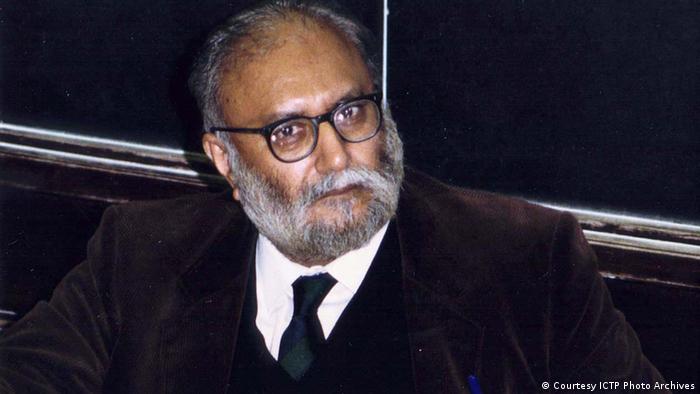
Dr.Abdus Salam: Pakistan refuses to own its 'heretic' scientist

http://www.dw.de
Pakistan remains silent about its only Nobel Laureate Abdus Salam and his contribution to the recent discovery of the
'God particle' because the late scientist belonged to the 'heretic' Ahmadiyya sect. Internationally, Professor Abdus Salam is known for his outstanding contribution to Physics and his groundbreaking work that led to the discovery of the so-called God Particle, but in Pakistan, where the late Nobel Laureate was born, Dr. Salam is a heretic, whose name has been removed from all text books. Salam's crime was that despite being a genius in the field of science, he was a member of the Ahmadiyya minority. The sect was declared non-Muslims by the Pakistani legislators in the 1973 constitution as part of its Islamization process. Thus, Pakistan disowned its only Nobel laureate."The Pakistani right wing is silent about Salam and the Higgs boson connection because it believes the discovery would support the scientist and the Ahmadiyyas," Amin Mughal, a London-based scholar, told DW.
Constitutional discrimination
The Islamization of Pakistan, which began during former Prime Minister Zulfiqar Ali Bhutto's government in the 1970s, culminated in the 1980s under the former military dictator General Zia-ul-Haq's Islamist regime. It was during Haq's oppressive rule when Ahmadiyyas (also known as Qadianis in Pakistan) were banned from calling themselves Muslim and building their mosques in the Islamic Republic. Their places of worship were shut down or desecrated by hard-line Islamists with the support of the state. Ahmadiyyas, who believe the messiah Ghulam Ahmed lived after the Prophet Muhammad, insist they are Muslim and demand as much right to practice their faith in Pakistan as other people.Baseer Naveed, senior researcher at the Asian Human Rights Commission in Hong Kong, told DW that the Pakistani state did not want to upset the fundamentalist sections of society by associating itself with an Ahmadiyya scientist. "It is to appease Muslim fundamentalists and right wing parties. More so, it is to appease Saudi Arabia. The Pakistani state is more interested in carrying on with its policy of hatred rather than taking pride in Abdus Salam's contributions," said Naveed. However, Mughal believes the issue is more political than religious. "Until recently, Ahmadis were a relatively strong group within the Pakistani establishment. The dominant Sunni groups felt threatened by them and axed them out of the state affairs," said Mughal. 'The Islamic bomb' Naveed pointed out that it seemed impossible for academics, scientists, writers and researchers to be declared national heroes in Pakistan. "Only warriors and usurpers are glorified," said Naveed. Pakistan's "science hero" happens to be the infamous Dr. Abdul Qadeer Khan, the father of Pakistan's atomic bomb - referred to by Pakistani right-wing groups as the "Islamic bomb." In 2004, Khan publicly confessed that he transferred the nuclear technology to countries like Iran and North Korea. Though the notorious scientist was put under house arrest by former military dictator Pervez Musharraf, Khan is still hailed by the many in Pakistan as country's 'savior.' Pakistan's liberal scholars say that the state takes more pride in and invests more money in developing missiles and nuclear warheads than in promoting actual scientific research. "Research in scientific development has almost stopped in the country," said Naveed, adding that only jihadist ideas and teachings are flourishing in Pakistan. "Most researchers from minority religious sects have already left the country, and those who are still in Pakistan are worried about their lives," he said.

Afghanistan's multimillion 'highway to nowhere'

A flagship multimillion-pound highway linking Afghanistan's major cities is of no use to the majority of the population and at risk of crumbling during the winter, a secret report presented to British ministers has warned. The 2,700km "Highway 1", largely bankrolled by American and Saudi millions, was seen as a symbol of Afghanistan's emergence as a modern democratic nation after decades of oppressive rule and conflict. But senior figures within the Foreign Office (FCO) have questioned the priority given to the project – and the standard of the finished road. A confidential paper under discussion in the department, seen by The Independent on Sunday, claims the road is not completely "metalled" with a durable surface, and has a layer of tarmac too thin to last an Afghan winter, leaving lengthy stretches in danger of disintegration. The document also complained that the highway was "of no value at all" to the vast majority of Afghans, who need better local roads to help them travel to towns closer to home. Highway 1, it seems, is the road to nowhere, a metaphor for costly, ill-planned development projects which have acted as a bran tub of kickbacks for corrupt officials. The US spending watchdog, the Special Inspector General for Afghanistan Reconstruction, has claimed that Washington cannot account for billions of dollars spent on aid projects in the country. The white elephants include: six Afghan National Police buildings so poorly constructed they were unusable; the Kabul Power Plant, built at a cost of $300m (£194m) to the US taxpayer, and beset by delays, cost increases and fit now only as an expensive back-up facility; and a project to upgrade the Kajaki Dam on the Helmand River which is years behind schedule, and for which a huge generator transported in pieces through a bitter fire fight with insurgents remains unassembled and rusting, partly because the concrete needed for its foundations was never delivered. The shortcomings of Highway 1 have emerged as more than 70 nations prepare to rubber-stamp almost £10bn in additional aid to the country over the next five years. The International Development Secretary, Andrew Mitchell, said the donors' conference in Tokyo today will demand that Afghanistan slash its budget shortfall in return. But the record of development aid ploughed into Afghanistan so far is questioned by the leaked report on the country's future. The paper, written by a senior figure in the FCO, labels Highway 1 as "a classic illustration of the challenges that continue to hinder a swifter economic recovery". It adds: "This major road system, started in 2002, is still not fully metalled due to a combination of siphoning away of funds, and contracts being outsourced through layers of companies. Once everyone has taken their cut, the layer of tarmac put down is too thin to last an Afghan winter. For the 91 per cent of Afghans who venture no further than their neighbouring town, it is of no value at all. More hearts and minds would have been won if a strategy was followed that linked together towns and the regional economic hubs, allowing market routes to open up." USAid (the US Agency for International Development) lists the road as one of its "major accomplishments" in Afghanistan, "giving Afghans better connections to their country's major transportation routes, and facilitating their access to markets, schools, health clinics and government services". But locally based critics have complained that the road is expensive to maintain, largely used by foreign military and aid traffic, and that it has become a magnet for roadside bomb attacks, Taliban offensives and illegal roadblocks. Thomas Ruttig, co-director of Afghanistan Analysts Network, said: "The international community has been throwing money at problems without making sure that it is used effectively. I would suggest that a group of key ambassadors be invited to travel by road from Kabul to Kandahar, then ask them again how many kilometres of road have been built and asphalted. In other words, counting kilometres doesn't say anything about how the roads can be used." The criticism of the roads strategy was reflected in a World Bank report earlier this year which concluded that Afghanistan's road network was crumbling away due to lack of maintenance over the past decade, with most donors more interested in building roads than keeping them in good order. The report, Afghanistan in Transition: Looking Beyond 2014, calculated it would cost £1.9bn to put the country's network into a maintainable state The £17.4m budget allocated for road maintenance this year – a fraction of the £187m needed – is "far too little to meet the road network's maintenance needs", the report states. The Department for International Development has pledged to improve monitoring of the £178m ploughed into Afghanistan every year, amid concerns that money intended for vital aid programmes is being diverted into the hands of local officials. Mr Mitchell last night told the IoS that the Tokyo conference aimed to "nail down" support for the Afghan leadership among ordinary citizens as foreign forces prepare to leave. Afghan President Hamid Karzai is expected to outline new anti-corruption and accountability measures, as he tries to win support for a funding package his officials have drawn up with the World Bank. Mr Mitchell said: "It is very important that our commitment continues. We are in Afghanistan in pursuit of Britain's national interests, so that it can no longer be a haven for terrorists." Of the criticisms of Highway 1, he said: "All these projects are difficult to deliver. Often we are working in extremely difficult circumstances."

Have Pakistan’s generals overplayed their hand in Afghanistan?

Daily Times
by:Sonali Ranade


What can Pakistan possibly gain from a total control of Afghanistan that it cannot gain otherwise by peaceful means?

Back in October 2011, I attempted to summarise Pakistan’s options in Afghanistan in light of the evolving situation then. The article is available at: http://dailytimes.com.pk/default.asp?page=2011%5C10%5C02%5Cstory_2-10-2011_pg3_5. The present attempt is to see how many of the assumptions I made then have come true and to reassess Pakistan’s options in relation to the new situation. The idea is not so much to stress what went wrong but to see how things can be set right in the interests of all stakeholders in Afghanistan. The focus of course will be on the play of interests of Afghanistan, Pakistan and India.

Begin by noting that the worst possible outcome of the Afghan conflict for Pakistan is at hand. Its key lies in the US determination to keep a few thousand Special Forces troops in Afghanistan for the next 10 years, complete with two or more dedicated airbases that will house drones and other fighters to protect them. In addition, the US and its allies will fund the Afghan national Army (ANA) for the next 10 years as it takes over security duties from US troops. The new US strategy is minimalist in deployment and works on the basis of denial of control of areas to the Taliban and their backers. While the US may not be able to prevent the Taliban from taking over some southern parts of Afghanistan, the US presence along with the ANA will ensure the north remains with those elements aligned with Kabul. It will be exceedingly difficult for Pakistan and its proxies to knock off completely both the ANA and the US forces to take full control over Afghanistan. In other words, should the parties fail to negotiate successfully, the arrangement ensures the continuation of a low intensity civil war in the country for the foreseeable future.

Iran, India, Russia and China have vital stakes in the area that Pakistan cannot overlook. None of them, not even China who is the closest to Pakistan in this group, is going to wait for Pakistan to prevail in Afghanistan. They will all move to secure their interests as best as they can, with Pakistan’s help if possible, without it if necessary. Pakistan has the capability to deny peace in Afghanistan but it can do so only at great expense to itself and at the risk of isolating itself from the world community. A prolongation of the conflict in Afghanistan has grave risks for Pakistan’s internal security and balance as well. Some of the state’s proxies are already out of control and others are exhibiting classic signs of developing political ambitions independently of their sponsors in the Pakistani ‘Deep State’. Pakistan’s GDP has been stagnating; its internal debt is too large in relation to both its GDP and the government’s revenue raising capacity. But for workers’ remittances from abroad, amounting to about $ 12 billion, Pakistan’s internal and external finances would be precarious. With a burgeoning population, deteriorating law and order, little investment, Pakistan cannot afford continuation of the conflict in Afghanistan indefinitely without risking an implosion at home. As it is, many investors are pulling out in the face of mounting political risks.

Be that as it may, why does Pakistan need to act as a spoiler in Afghanistan? What can Pakistan possibly gain from a total control of Afghanistan that it cannot gain otherwise by peaceful means? Where do Pakistan’s true interests lie in Afghanistan and how are they best secured?

First, let us get the nonsense about strategic depth out of the way. With a nuclear arsenal that is now larger than India’s, does Pakistan really fear an Indian armoured blitz that will cut Pakistan into two halves in a matter of days? With China sitting pretty in Kashmir and Afghanistan, can India really confront Pakistan with a two-front situation using Afghanistan? In other words, the old security arguments that called for complete domination of Afghanistan by Pakistan and its proxies are more or less irrelevant in the evolving situation. Absent these considerations, what else can Pakistan really achieve by a full domination in Afghanistan?

The overland oil routes to Iran from India and China, and access to Central Asia by India remain two valid considerations for Pakistan to seek influence in Afghanistan. But does such influence need to be complete dominance? The fact of the matter is that Pakistan cannot encash the economic value of its strategic position in relation to Central Asia without a cooperative relationship with Afghanistan and the rest of the players that include Iran, Russia, China, India and the US. Unless the interests of all of these players are accommodated, India, Iran or China will never fully trust their strategic trade routes to Pakistani dominance. Pakistan simply cannot afford to wait indefinitely for the day when Afghanistan will fall into its lap and it will then decide how to accommodate the others and on what terms. The time to figure out a via media is now or perhaps never.

The US retains several vital coercive cards to play in the Afghan-Pakistan status quo should Pakistani belligerence continue. The Americans are old hands at using insurgency as a weapon of destabilisation and Pakistan’s north and south offer fertile areas where the US could engineer a counter-offensive. Balochistan is an obvious candidate for many reasons. Denying Gwadar port to the Chinese, bottling up Pakistan and opening a sea route for Afghanistan independently of Pakistan come to mind. The local insurgency in Balochistan, a result of past colossal mistakes, offers a convenient cover. Denial of trade, aid, and restrictions on access to external financing are other cards that the US will seek to play to keep Pakistani aggression in Afghanistan in check. So overall, Pakistan’s strategic capacity to defy the US indefinitely in Afghanistan is very limited now. It did hold a trump card in terms of logistics before it played the card. Its generals recklessly threw away the card in a fit of unprofessional pique or perhaps it was acute political embarrassment?

Pakistan has nothing to lose by coming to the negotiating table with the US and others and everything to gain from it. By negotiating, it can give itself another chance in Afghanistan. Therefore, one should expect Pakistan’s Deep State to recognise the obvious compulsions and find a way to return to the table. However, Pakistan needs to reassess earnestly its entire strategy in Afghanistan top to bottom. Pakistan is playing a 19th century game of trade routes in the 21st century. The world is getting smaller and more tightly integrated by the day. The US began its Iraq adventure thinking the country was its legitimate share of the spoils of war. Much blood and treasure later, and a near total loss of face, it realised that in the television age, one could not own another country even as the world’s only superpower. The Afghans are no pushovers. Pakistan needs to think Pakistan first, India last — not the other way around.

IMRAN & NAWAZ VS REVOLUTION!!!!

BY: M WAQAR
For the last few years Nawaz and Imran are talking about revolution in their Country but seems like either both are confused with the word ‘’REVOLUTION’’ or don’t have any revolutionary thinking, but their goal is to get to the PM house in Islamabad, may be that is their revolution. I think both of em not only need to study the constitution of Pakistan but also needs to know the definition of revolution, although Nawaz with the help of ISI was ‘’selected’’ twice as PM and he could fulfill his thrust for revolution; he had a chance to bring revolution in Pakistani agriculture, education, society and could develop Pakistan like Malaysia or Indonesia, but unfortunately during his tenure poor were selling kids and kidneys and only development, and progress was made in RAIWIND. According to his latest statement,’’ 'My team will bring revolution in the country', To me its funny when NAWAZ SHARIF talks about revolution, His revolution is for himself not for Pakistani people, he wants a revolution so he can become Prime Minister and lets not forget that Nawaz was PM not once but twice, so what happen then?,he had all the power and he could change Pakistan , he could get rid of what he is talking about now . It is obvious that Nawaz Sharif is playing a dangerous game using Punjabi ethnicity for his political gains in Pakistan and he is not alone, Imran Khan even wants to use Taliban for revolution,If anyone thinks Mr Sharif’s idea of “revolution” goes beyond this, he/she should get the Nobel Prize for Misplaced Optimism. Nawaz Sharif is once again trying to revive Pujabi chauvinism in Pakistan,’’ Jaag Punjabi Jaag Teri Pag Noon Lag Gaya Daagh. “” Obviously what Nawaz Sharif promised the nation, was not a revolution in the real sense but merely a regime-change to his liking. Nawaz Sharif talks about NRO but he forgets about his agreement with dictator Musharaf, he talks about judiciary but forgets his attack on supreme court, he talks about media but forgets what he did to Rehmat Shah Afridi of FP,Jang Group and others, he forgets what he did to Junejo. He talks about democracy but he forgot it while making forward block .Nawaz Sharif needs power and his style of revolution for power and money. Where was his revolution when Nawaz Sharif spent his time at Surror Palace in Jeddah and then in England and poor Pakistanis were selling kids and kidneys. Shahbaz Sharif and Mian Nawaz Sharif both are convicted criminals, in a unconstitutional deal with the military dictator General Pervez Musharaf, both of them went into exile with a promise to stop participating in politics . I am sure Nawaz and Imran can't be Mao, Lenin, Washington, Ataturk because both don’t have those qualities, both belong to the old elite club of Pakistani bourgeois feudal system. Although Imran is a new kid on the block in political arena, but his problem is he is following footsteps of his mentor QAZI Hussain and loves politics of agitation, slogans and tall claims to defeat his opponents, of curse politics is different than cricket game, obviously he does not have any agenda, he never condemned Taliban, if he wants to be a revolutionary leader, he should challenge blasphemy law, talk about minority's sufferings, women rights, etc., which are hot and sensitive issues in Pakistan besides poverty, corruption and millions of other problems citizens of Pakistan are facing for the last 65 years. In politics you don’t have to be a good looking guy or gal, Democracy is a greatest form of Govt,but Pakistan is a very different and complex society where you are dealing with over fifty million people who are illiterate, Clearing away the feudal influence left from thousands of years and clearly framing democratic boundaries are both important to Pakistan’s political structure. There are few countries today that can survive with authoritarian governments.I might sound anti-democracy but let’s face the fact in Pakistani case, Educated citizens are the most important group for Democracy. In Europe and America democracy is successful cause their citizens are well educated and well aware of their rights and duties, where politicians can’t make their voters chump all the time, in case of political and constitutional issues, Mr. Imran Khan had to first understand what the people want and what the Government can give or deliver within the framework of Pakistan as he is interested to make his Tehrik-i-Insaf as majority party in the Parliament and become the Prime Minister. If Imran want to be the ATATURK OR MAO of Pakistan then he needs to change his mentality and should gain some political maturity. A revolutionary guy for Pakistan can’t play as westernized boy in his drawing room and then try to placate mullah and placate Army while presenting himself as the acceptable face of Pakistan. Revolutionary leaders don’t have mentors, they are born naturally as revolutionary, If it is true that General Gul is Imran Khan’s political mentor, influencing his sympathies for religious extremism, it is not a good omen for Pakistan, which is already in a vortex of terrorist violence , Imran’s politics is not so straightforward. A man of his background living in both Islamic and western cultures, and now leaning towards religious conservatism, is a contradiction. Such metamorphism can only be described as political opportunism. His sympathies are more with the religious right, earning him, in some quarters, the title of ‘Taliban Khan’. He believes that the country’s militants can be won over through talks. He is pushing the popular anti-US line, advocates freeing Pakistan of US and western aid. But he is sketchy on how all this will solve the country’s myriad problems. There is a certain political naivety about the man. There are no detailed policy prescriptions to take the country ahead. To take one important aspect: has he got a policy framework to conduct dialog with the Taliban? How will they be accommodated? Will ‘Prime Minister’ Imran Khan agree to run the country on the Taliban’s interpretation of Islam? There is no clarity about the path Pakistan will tread under him. Imran runs the biggest charitable institute, But one cannot run a country like a charitable institute. One thing that will keep popping up from time to time is the contradiction in Imran Khan’s personal life, which will increasingly become public as he gets closer to the top office. That is: his increasing reliance on Islamic politics while straddling both sides of the cultural divide. Amanda Hodge puts it cryptically in her article in The Australian. She writes: “Despite his best efforts, his previous reputation [as a playboy] has not forsaken him. Rumors abound of Khan — still slick from a home gym workout — greeting one female [western] journalist in only a pair of brief running shorts, and of conducting an interview with another in his bedroom.” She adds, “The philandering reputation continues to dog Khan — and has led some to call into question his attitude towards women.” Be that as it may, Khan’s Tehreek-e-Insaf is no revolution — soft or otherwise. The rising support for Imran Khan, especially among the youth, might be a good thing but the way Imran Khan has been supporting the Taliban and tribal justice is dangerous for future politics in Pakistan. This all seems like Imran will disappoint the people ,the youth and there will be no change in Pakistan, may be under PRIME MINISTER IMRAN Pakistan will become one isolated Country in the World,but then the question is if you refuse to take aid from U.S.A and other countries(which is fine) then are you able to improve your agriculture, build factories, industries, create jobs, provide free health care to your citizens,curtail child labor and a million dollar question how Prime Minister Imran will refuse aid for his military, who has been dependent on US aid for many years, nearly $ 20 billion in the past 10 years alone, also half of all Pakistanis live below the poverty line and 75 percent live on $ 2 or less a day. There is unprecedented inflation, lawlessness, unemployment, gas shortages,plush how to deal with bureaucracy?. There are target killings in Karachi and Baluchistan, all along the tribal belt there’s an insurgency and a total collapse of state institutions, so if he thinks that he is the Savior of Pakistan, and that’s what people believe too, he needs to come out clean and instead of calling Zardari thief day N night, he needs to show his agenda, policies of PRIME MINISTER IMRAN KHAN.Revolutionary Imran Khan should not be a typical Pakistani politician.The problem with Pakistani politicians is, when they are in opposition they blame current Govt, when they get power they waist time in blaming previous regime but they do nothing for the nation except for themselves, If Imran is thinking that he will behave like Gaddafi of Libya or Iran’s Ahmadinejad then he is living in fool’s paradise, IRAN and Libya got power of oil and more developed then Pakistan who could live without foreign aid and can afford challenging big global powers and players, let’s face reality, Pakistan is a failed state, depends on IMF ,U.S.,WEST etc. Revolutionary leaders don’t jump on gravy trains and the problem with Pakistani politician is they are all on the bandwagon of others. They just make tall claims to get elected and then forget the miseries of the people. Revolutionary leaders are not born in the palaces of bourgeois’ but are born in the homes of peasants, factory workers. Nawaz and Imran are both just interested in changing the guard, taking over the reins of power then just play ''Mr. PRIME MINISTER.'' So will that change Pakistan, ’’NO’’. Pakistan needs new generation of politicians who are not family members of past hypocrites, dictators and traitors, Pakistani political parties never developed into viable institutions capable of generating leadership. There are talented emerging politicians in some political parties of Pakistan but they stand no chance of occupying their party top slots. Only the educated people can help break the choking grip of wealthy, autocratic feudal politicians. In Pakistan the military has been part of the problem because it has been encouraging the monopoly of a handful of politicians in the country, perpetuating a troubled system and never encouraging its replacement with a better one. The prevalent feudal system of Pakistan is the main obstacle in the progress of the country and the prosperity of the people. Since the creation of Pakistan the Pakistani people are left at distant from the corridor of power so that the ruling elite can do what they wanted to do in favor of their interest, leaving the Pakistani people at the mercy of circumstances. As this policy is denial of right of Pakistani people to rule their country according to their aspiration and desire to build this country, which can provide equal opportunity to all without any discrimination for the establishment of welfare society. It would be wrong to blame Pakistan army alone for having usurped power for more than half of its life. It was in fact feudal corrupt politicians that facilitated first martial law in Pakistan and again in 1999. How long shall we suffer? How long the future of our coming generation will be at stake. With a population of over 160 million, Pakistan is the sixth most populous country in the world and the second most populous country with a Muslim majority. However, the country faces significant development challenges, with one in 10 children dying before their fifth birthday, and 50% of adults classed as illiterate, no clean drinking water, load shedding and so many other countless problems Pakistanis face every day. Pakistani politicians failed to develop stability in Pakistan, because they lack an all-Pakistan vision. The entire Pakistani political class is composed of thieves waiting to stab each other in the back given the slightest opportunity, in order to feed like pigs at the trough, looting the public coffers instead of working for Pakistan's betterment. What hope can the common Pakistani have? Democracy can not work in Pakistan unless and until the country gets rid itself from the culture of dynastic rulers, feudal lords, capricious, greedy rich politicians and military generals who have monopolized and manipulated Pakistan for the last sixty one years for their personal interests. These corrupt politicians have now the last chance to save Pakistan from collapsing if their intentions are honest and patriotic but if as always in the past, they are only interested in the thickness of their wallets; the country is doomed as it is surrounded by enemies within and around its borders. Pakistan is sinking into a deep hole dug by the corrupt politicians who quarrel incessantly about anything and everything and can never agree on anything, and that is the biggest tragedy of Pakistan. The Pakistanis are sick and tired of politicians’ never ending squabbling, reminiscing their past, each other failures and never discussing what they could do for the country in the future. They are stuck in the past and if you were watch them on TV; all they would do is to discuss the present, past, and ignoring the fact that each one of them is responsible for the gradual fragmentation of their country. Pakistan does not need to be told by the foreigners what to do with their internal and external affairs and all they need is to resolve their disputes, petty squabbles and to stand united to faces internal and external threats. Pakistani politicians must grow up to be men if they wished to save their country from breaking up into many pieces. They must look at Iraq and learn a lesson that their kitchen politics will lead them into a quagmire and sink their country with them. Pakistanis do not need buttery words, false promises, false direction, false hopes and dreams from these inept perennial squabbling politicians. It is imperative to put in place a system that would require end of dynastic, elitist, feudal and generals ruling the country. Democracy is a delicate system of governance that can be sustained only if the political class fully subscribes to and implements its basic norms in letter and spirit. The use of violence in the name of exercising the democratic right to protest shows a lack of understanding of the spirit of democracy. Where is the discussion about the higher education in Pakistan? How are the top notch scientists, engineers and doctors going to be trained? When will govt start pouring funds into these fields? There is also EDUCATIONAL FAILURE in Pakistan, a country with over 40 million illiterate people can’t progress and develop. The lack of modern schools and scientific education shows no potential for Pakistan to develop economically or politically in the future. Pakistani elite betraying the better educated parts of its population and turn itself into a backward nation, and they are doing it so they can rule and no one can question them .Pakistan as a nation is failing miserably and corrupt and opportunist politicians and power hungry Generals are responsible for that. If Pakistan is bankrupt ,even all the loans from IMF, World Bank, Paris Club, London Club, overt and covert aid from US, and repeated refinancing of the debt have not worked because all that aid was stolen by Pakistani elite, politicians and Army Generals. Today we see POLITICAL FAILURE in Pakistan because of The military coups, suspension of constitutional law, murders of Bhuttos , reveal no evidence of a modern political culture or democracy and none of the politicians of this country were sincere to help growing that political culture in Pakistan, Pakistani politicians have no agenda for growth or development; no plans for health and education meaningful. Most of the Politicians lack qualifications, experience and even commitment to tackle the problems of the Country. Politics and power dominates their agenda and real issues of poverty, illiteracy and disease do not fare in their book. Anyone who expects them to lead the country to peace and prosperity must be dreaming. The representatives of the people need to pass certain tests of eligibility. Character, ability, a sense of responsibility and experience are necessary ingredients of that eligibility, but in Pakistani Politics we don’t see that PMLN leaders think that democracy is relevant only to the extent that it facilitates the achievement of their partisan political agenda. If Nawaz Sharif is so sincere then why he never talks about women rights, but PML(N) opposed bill against domestic violence. If Nawaz believes he is a revolutionary then what is view point on so called blasphemy law, Taliban destroying schools etc. PMLN leaders think that democracy is relevant only to the extent that it facilitates the achievement of their partisan political agenda. By the age of 65, a COUNTRY - like a man - should have achieved a certain maturity. After decades of existence we know, for good and for bad, which we are, what we have done and how we appear to others, warts and all. But unfortunately, Pakistan remains curiously immature; a Country with less than 50% rate of literacy can’t bring political wisdom that usually accompanies age. Therefore, Pakistanis needs to wake up, stand up for their rights and reject these corrupt and failed politicians. If IMRAN KHAN can handle all these challenges and is able to solve these problems Pakistan facing then I wish him a good luck, otherwise Please don’t use word ‘’REVOLUTION’’ if you(IK) JUST WANT TO RAISE SLOGANS TO GET POPULAR AND BECOME PRIME MINISTER.