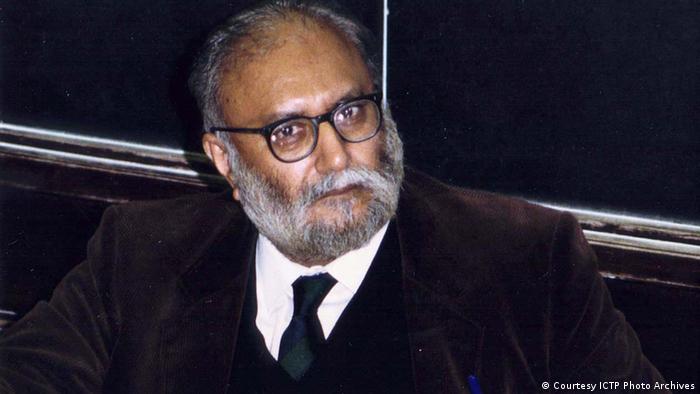
Dr.Abdus Salam: Pakistan refuses to own its 'heretic' scientist

http://www.dw.de
Pakistan remains silent about its only Nobel Laureate Abdus Salam and his contribution to the recent discovery of the
'God particle' because the late scientist belonged to the 'heretic' Ahmadiyya sect. Internationally, Professor Abdus Salam is known for his outstanding contribution to Physics and his groundbreaking work that led to the discovery of the so-called God Particle, but in Pakistan, where the late Nobel Laureate was born, Dr. Salam is a heretic, whose name has been removed from all text books. Salam's crime was that despite being a genius in the field of science, he was a member of the Ahmadiyya minority. The sect was declared non-Muslims by the Pakistani legislators in the 1973 constitution as part of its Islamization process. Thus, Pakistan disowned its only Nobel laureate."The Pakistani right wing is silent about Salam and the Higgs boson connection because it believes the discovery would support the scientist and the Ahmadiyyas," Amin Mughal, a London-based scholar, told DW.
Constitutional discrimination
The Islamization of Pakistan, which began during former Prime Minister Zulfiqar Ali Bhutto's government in the 1970s, culminated in the 1980s under the former military dictator General Zia-ul-Haq's Islamist regime. It was during Haq's oppressive rule when Ahmadiyyas (also known as Qadianis in Pakistan) were banned from calling themselves Muslim and building their mosques in the Islamic Republic. Their places of worship were shut down or desecrated by hard-line Islamists with the support of the state. Ahmadiyyas, who believe the messiah Ghulam Ahmed lived after the Prophet Muhammad, insist they are Muslim and demand as much right to practice their faith in Pakistan as other people.Baseer Naveed, senior researcher at the Asian Human Rights Commission in Hong Kong, told DW that the Pakistani state did not want to upset the fundamentalist sections of society by associating itself with an Ahmadiyya scientist. "It is to appease Muslim fundamentalists and right wing parties. More so, it is to appease Saudi Arabia. The Pakistani state is more interested in carrying on with its policy of hatred rather than taking pride in Abdus Salam's contributions," said Naveed. However, Mughal believes the issue is more political than religious. "Until recently, Ahmadis were a relatively strong group within the Pakistani establishment. The dominant Sunni groups felt threatened by them and axed them out of the state affairs," said Mughal. 'The Islamic bomb' Naveed pointed out that it seemed impossible for academics, scientists, writers and researchers to be declared national heroes in Pakistan. "Only warriors and usurpers are glorified," said Naveed. Pakistan's "science hero" happens to be the infamous Dr. Abdul Qadeer Khan, the father of Pakistan's atomic bomb - referred to by Pakistani right-wing groups as the "Islamic bomb." In 2004, Khan publicly confessed that he transferred the nuclear technology to countries like Iran and North Korea. Though the notorious scientist was put under house arrest by former military dictator Pervez Musharraf, Khan is still hailed by the many in Pakistan as country's 'savior.' Pakistan's liberal scholars say that the state takes more pride in and invests more money in developing missiles and nuclear warheads than in promoting actual scientific research. "Research in scientific development has almost stopped in the country," said Naveed, adding that only jihadist ideas and teachings are flourishing in Pakistan. "Most researchers from minority religious sects have already left the country, and those who are still in Pakistan are worried about their lives," he said.

Afghanistan's multimillion 'highway to nowhere'

A flagship multimillion-pound highway linking Afghanistan's major cities is of no use to the majority of the population and at risk of crumbling during the winter, a secret report presented to British ministers has warned. The 2,700km "Highway 1", largely bankrolled by American and Saudi millions, was seen as a symbol of Afghanistan's emergence as a modern democratic nation after decades of oppressive rule and conflict. But senior figures within the Foreign Office (FCO) have questioned the priority given to the project – and the standard of the finished road. A confidential paper under discussion in the department, seen by The Independent on Sunday, claims the road is not completely "metalled" with a durable surface, and has a layer of tarmac too thin to last an Afghan winter, leaving lengthy stretches in danger of disintegration. The document also complained that the highway was "of no value at all" to the vast majority of Afghans, who need better local roads to help them travel to towns closer to home. Highway 1, it seems, is the road to nowhere, a metaphor for costly, ill-planned development projects which have acted as a bran tub of kickbacks for corrupt officials. The US spending watchdog, the Special Inspector General for Afghanistan Reconstruction, has claimed that Washington cannot account for billions of dollars spent on aid projects in the country. The white elephants include: six Afghan National Police buildings so poorly constructed they were unusable; the Kabul Power Plant, built at a cost of $300m (£194m) to the US taxpayer, and beset by delays, cost increases and fit now only as an expensive back-up facility; and a project to upgrade the Kajaki Dam on the Helmand River which is years behind schedule, and for which a huge generator transported in pieces through a bitter fire fight with insurgents remains unassembled and rusting, partly because the concrete needed for its foundations was never delivered. The shortcomings of Highway 1 have emerged as more than 70 nations prepare to rubber-stamp almost £10bn in additional aid to the country over the next five years. The International Development Secretary, Andrew Mitchell, said the donors' conference in Tokyo today will demand that Afghanistan slash its budget shortfall in return. But the record of development aid ploughed into Afghanistan so far is questioned by the leaked report on the country's future. The paper, written by a senior figure in the FCO, labels Highway 1 as "a classic illustration of the challenges that continue to hinder a swifter economic recovery". It adds: "This major road system, started in 2002, is still not fully metalled due to a combination of siphoning away of funds, and contracts being outsourced through layers of companies. Once everyone has taken their cut, the layer of tarmac put down is too thin to last an Afghan winter. For the 91 per cent of Afghans who venture no further than their neighbouring town, it is of no value at all. More hearts and minds would have been won if a strategy was followed that linked together towns and the regional economic hubs, allowing market routes to open up." USAid (the US Agency for International Development) lists the road as one of its "major accomplishments" in Afghanistan, "giving Afghans better connections to their country's major transportation routes, and facilitating their access to markets, schools, health clinics and government services". But locally based critics have complained that the road is expensive to maintain, largely used by foreign military and aid traffic, and that it has become a magnet for roadside bomb attacks, Taliban offensives and illegal roadblocks. Thomas Ruttig, co-director of Afghanistan Analysts Network, said: "The international community has been throwing money at problems without making sure that it is used effectively. I would suggest that a group of key ambassadors be invited to travel by road from Kabul to Kandahar, then ask them again how many kilometres of road have been built and asphalted. In other words, counting kilometres doesn't say anything about how the roads can be used." The criticism of the roads strategy was reflected in a World Bank report earlier this year which concluded that Afghanistan's road network was crumbling away due to lack of maintenance over the past decade, with most donors more interested in building roads than keeping them in good order. The report, Afghanistan in Transition: Looking Beyond 2014, calculated it would cost £1.9bn to put the country's network into a maintainable state The £17.4m budget allocated for road maintenance this year – a fraction of the £187m needed – is "far too little to meet the road network's maintenance needs", the report states. The Department for International Development has pledged to improve monitoring of the £178m ploughed into Afghanistan every year, amid concerns that money intended for vital aid programmes is being diverted into the hands of local officials. Mr Mitchell last night told the IoS that the Tokyo conference aimed to "nail down" support for the Afghan leadership among ordinary citizens as foreign forces prepare to leave. Afghan President Hamid Karzai is expected to outline new anti-corruption and accountability measures, as he tries to win support for a funding package his officials have drawn up with the World Bank. Mr Mitchell said: "It is very important that our commitment continues. We are in Afghanistan in pursuit of Britain's national interests, so that it can no longer be a haven for terrorists." Of the criticisms of Highway 1, he said: "All these projects are difficult to deliver. Often we are working in extremely difficult circumstances."

Have Pakistan’s generals overplayed their hand in Afghanistan?

Daily Times
by:Sonali Ranade


What can Pakistan possibly gain from a total control of Afghanistan that it cannot gain otherwise by peaceful means?

Back in October 2011, I attempted to summarise Pakistan’s options in Afghanistan in light of the evolving situation then. The article is available at: http://dailytimes.com.pk/default.asp?page=2011%5C10%5C02%5Cstory_2-10-2011_pg3_5. The present attempt is to see how many of the assumptions I made then have come true and to reassess Pakistan’s options in relation to the new situation. The idea is not so much to stress what went wrong but to see how things can be set right in the interests of all stakeholders in Afghanistan. The focus of course will be on the play of interests of Afghanistan, Pakistan and India.

Begin by noting that the worst possible outcome of the Afghan conflict for Pakistan is at hand. Its key lies in the US determination to keep a few thousand Special Forces troops in Afghanistan for the next 10 years, complete with two or more dedicated airbases that will house drones and other fighters to protect them. In addition, the US and its allies will fund the Afghan national Army (ANA) for the next 10 years as it takes over security duties from US troops. The new US strategy is minimalist in deployment and works on the basis of denial of control of areas to the Taliban and their backers. While the US may not be able to prevent the Taliban from taking over some southern parts of Afghanistan, the US presence along with the ANA will ensure the north remains with those elements aligned with Kabul. It will be exceedingly difficult for Pakistan and its proxies to knock off completely both the ANA and the US forces to take full control over Afghanistan. In other words, should the parties fail to negotiate successfully, the arrangement ensures the continuation of a low intensity civil war in the country for the foreseeable future.

Iran, India, Russia and China have vital stakes in the area that Pakistan cannot overlook. None of them, not even China who is the closest to Pakistan in this group, is going to wait for Pakistan to prevail in Afghanistan. They will all move to secure their interests as best as they can, with Pakistan’s help if possible, without it if necessary. Pakistan has the capability to deny peace in Afghanistan but it can do so only at great expense to itself and at the risk of isolating itself from the world community. A prolongation of the conflict in Afghanistan has grave risks for Pakistan’s internal security and balance as well. Some of the state’s proxies are already out of control and others are exhibiting classic signs of developing political ambitions independently of their sponsors in the Pakistani ‘Deep State’. Pakistan’s GDP has been stagnating; its internal debt is too large in relation to both its GDP and the government’s revenue raising capacity. But for workers’ remittances from abroad, amounting to about $ 12 billion, Pakistan’s internal and external finances would be precarious. With a burgeoning population, deteriorating law and order, little investment, Pakistan cannot afford continuation of the conflict in Afghanistan indefinitely without risking an implosion at home. As it is, many investors are pulling out in the face of mounting political risks.

Be that as it may, why does Pakistan need to act as a spoiler in Afghanistan? What can Pakistan possibly gain from a total control of Afghanistan that it cannot gain otherwise by peaceful means? Where do Pakistan’s true interests lie in Afghanistan and how are they best secured?

First, let us get the nonsense about strategic depth out of the way. With a nuclear arsenal that is now larger than India’s, does Pakistan really fear an Indian armoured blitz that will cut Pakistan into two halves in a matter of days? With China sitting pretty in Kashmir and Afghanistan, can India really confront Pakistan with a two-front situation using Afghanistan? In other words, the old security arguments that called for complete domination of Afghanistan by Pakistan and its proxies are more or less irrelevant in the evolving situation. Absent these considerations, what else can Pakistan really achieve by a full domination in Afghanistan?

The overland oil routes to Iran from India and China, and access to Central Asia by India remain two valid considerations for Pakistan to seek influence in Afghanistan. But does such influence need to be complete dominance? The fact of the matter is that Pakistan cannot encash the economic value of its strategic position in relation to Central Asia without a cooperative relationship with Afghanistan and the rest of the players that include Iran, Russia, China, India and the US. Unless the interests of all of these players are accommodated, India, Iran or China will never fully trust their strategic trade routes to Pakistani dominance. Pakistan simply cannot afford to wait indefinitely for the day when Afghanistan will fall into its lap and it will then decide how to accommodate the others and on what terms. The time to figure out a via media is now or perhaps never.

The US retains several vital coercive cards to play in the Afghan-Pakistan status quo should Pakistani belligerence continue. The Americans are old hands at using insurgency as a weapon of destabilisation and Pakistan’s north and south offer fertile areas where the US could engineer a counter-offensive. Balochistan is an obvious candidate for many reasons. Denying Gwadar port to the Chinese, bottling up Pakistan and opening a sea route for Afghanistan independently of Pakistan come to mind. The local insurgency in Balochistan, a result of past colossal mistakes, offers a convenient cover. Denial of trade, aid, and restrictions on access to external financing are other cards that the US will seek to play to keep Pakistani aggression in Afghanistan in check. So overall, Pakistan’s strategic capacity to defy the US indefinitely in Afghanistan is very limited now. It did hold a trump card in terms of logistics before it played the card. Its generals recklessly threw away the card in a fit of unprofessional pique or perhaps it was acute political embarrassment?

Pakistan has nothing to lose by coming to the negotiating table with the US and others and everything to gain from it. By negotiating, it can give itself another chance in Afghanistan. Therefore, one should expect Pakistan’s Deep State to recognise the obvious compulsions and find a way to return to the table. However, Pakistan needs to reassess earnestly its entire strategy in Afghanistan top to bottom. Pakistan is playing a 19th century game of trade routes in the 21st century. The world is getting smaller and more tightly integrated by the day. The US began its Iraq adventure thinking the country was its legitimate share of the spoils of war. Much blood and treasure later, and a near total loss of face, it realised that in the television age, one could not own another country even as the world’s only superpower. The Afghans are no pushovers. Pakistan needs to think Pakistan first, India last — not the other way around.

IMRAN & NAWAZ VS REVOLUTION!!!!

BY: M WAQAR
For the last few years Nawaz and Imran are talking about revolution in their Country but seems like either both are confused with the word ‘’REVOLUTION’’ or don’t have any revolutionary thinking, but their goal is to get to the PM house in Islamabad, may be that is their revolution. I think both of em not only need to study the constitution of Pakistan but also needs to know the definition of revolution, although Nawaz with the help of ISI was ‘’selected’’ twice as PM and he could fulfill his thrust for revolution; he had a chance to bring revolution in Pakistani agriculture, education, society and could develop Pakistan like Malaysia or Indonesia, but unfortunately during his tenure poor were selling kids and kidneys and only development, and progress was made in RAIWIND. According to his latest statement,’’ 'My team will bring revolution in the country', To me its funny when NAWAZ SHARIF talks about revolution, His revolution is for himself not for Pakistani people, he wants a revolution so he can become Prime Minister and lets not forget that Nawaz was PM not once but twice, so what happen then?,he had all the power and he could change Pakistan , he could get rid of what he is talking about now . It is obvious that Nawaz Sharif is playing a dangerous game using Punjabi ethnicity for his political gains in Pakistan and he is not alone, Imran Khan even wants to use Taliban for revolution,If anyone thinks Mr Sharif’s idea of “revolution” goes beyond this, he/she should get the Nobel Prize for Misplaced Optimism. Nawaz Sharif is once again trying to revive Pujabi chauvinism in Pakistan,’’ Jaag Punjabi Jaag Teri Pag Noon Lag Gaya Daagh. “” Obviously what Nawaz Sharif promised the nation, was not a revolution in the real sense but merely a regime-change to his liking. Nawaz Sharif talks about NRO but he forgets about his agreement with dictator Musharaf, he talks about judiciary but forgets his attack on supreme court, he talks about media but forgets what he did to Rehmat Shah Afridi of FP,Jang Group and others, he forgets what he did to Junejo. He talks about democracy but he forgot it while making forward block .Nawaz Sharif needs power and his style of revolution for power and money. Where was his revolution when Nawaz Sharif spent his time at Surror Palace in Jeddah and then in England and poor Pakistanis were selling kids and kidneys. Shahbaz Sharif and Mian Nawaz Sharif both are convicted criminals, in a unconstitutional deal with the military dictator General Pervez Musharaf, both of them went into exile with a promise to stop participating in politics . I am sure Nawaz and Imran can't be Mao, Lenin, Washington, Ataturk because both don’t have those qualities, both belong to the old elite club of Pakistani bourgeois feudal system. Although Imran is a new kid on the block in political arena, but his problem is he is following footsteps of his mentor QAZI Hussain and loves politics of agitation, slogans and tall claims to defeat his opponents, of curse politics is different than cricket game, obviously he does not have any agenda, he never condemned Taliban, if he wants to be a revolutionary leader, he should challenge blasphemy law, talk about minority's sufferings, women rights, etc., which are hot and sensitive issues in Pakistan besides poverty, corruption and millions of other problems citizens of Pakistan are facing for the last 65 years. In politics you don’t have to be a good looking guy or gal, Democracy is a greatest form of Govt,but Pakistan is a very different and complex society where you are dealing with over fifty million people who are illiterate, Clearing away the feudal influence left from thousands of years and clearly framing democratic boundaries are both important to Pakistan’s political structure. There are few countries today that can survive with authoritarian governments.I might sound anti-democracy but let’s face the fact in Pakistani case, Educated citizens are the most important group for Democracy. In Europe and America democracy is successful cause their citizens are well educated and well aware of their rights and duties, where politicians can’t make their voters chump all the time, in case of political and constitutional issues, Mr. Imran Khan had to first understand what the people want and what the Government can give or deliver within the framework of Pakistan as he is interested to make his Tehrik-i-Insaf as majority party in the Parliament and become the Prime Minister. If Imran want to be the ATATURK OR MAO of Pakistan then he needs to change his mentality and should gain some political maturity. A revolutionary guy for Pakistan can’t play as westernized boy in his drawing room and then try to placate mullah and placate Army while presenting himself as the acceptable face of Pakistan. Revolutionary leaders don’t have mentors, they are born naturally as revolutionary, If it is true that General Gul is Imran Khan’s political mentor, influencing his sympathies for religious extremism, it is not a good omen for Pakistan, which is already in a vortex of terrorist violence , Imran’s politics is not so straightforward. A man of his background living in both Islamic and western cultures, and now leaning towards religious conservatism, is a contradiction. Such metamorphism can only be described as political opportunism. His sympathies are more with the religious right, earning him, in some quarters, the title of ‘Taliban Khan’. He believes that the country’s militants can be won over through talks. He is pushing the popular anti-US line, advocates freeing Pakistan of US and western aid. But he is sketchy on how all this will solve the country’s myriad problems. There is a certain political naivety about the man. There are no detailed policy prescriptions to take the country ahead. To take one important aspect: has he got a policy framework to conduct dialog with the Taliban? How will they be accommodated? Will ‘Prime Minister’ Imran Khan agree to run the country on the Taliban’s interpretation of Islam? There is no clarity about the path Pakistan will tread under him. Imran runs the biggest charitable institute, But one cannot run a country like a charitable institute. One thing that will keep popping up from time to time is the contradiction in Imran Khan’s personal life, which will increasingly become public as he gets closer to the top office. That is: his increasing reliance on Islamic politics while straddling both sides of the cultural divide. Amanda Hodge puts it cryptically in her article in The Australian. She writes: “Despite his best efforts, his previous reputation [as a playboy] has not forsaken him. Rumors abound of Khan — still slick from a home gym workout — greeting one female [western] journalist in only a pair of brief running shorts, and of conducting an interview with another in his bedroom.” She adds, “The philandering reputation continues to dog Khan — and has led some to call into question his attitude towards women.” Be that as it may, Khan’s Tehreek-e-Insaf is no revolution — soft or otherwise. The rising support for Imran Khan, especially among the youth, might be a good thing but the way Imran Khan has been supporting the Taliban and tribal justice is dangerous for future politics in Pakistan. This all seems like Imran will disappoint the people ,the youth and there will be no change in Pakistan, may be under PRIME MINISTER IMRAN Pakistan will become one isolated Country in the World,but then the question is if you refuse to take aid from U.S.A and other countries(which is fine) then are you able to improve your agriculture, build factories, industries, create jobs, provide free health care to your citizens,curtail child labor and a million dollar question how Prime Minister Imran will refuse aid for his military, who has been dependent on US aid for many years, nearly $ 20 billion in the past 10 years alone, also half of all Pakistanis live below the poverty line and 75 percent live on $ 2 or less a day. There is unprecedented inflation, lawlessness, unemployment, gas shortages,plush how to deal with bureaucracy?. There are target killings in Karachi and Baluchistan, all along the tribal belt there’s an insurgency and a total collapse of state institutions, so if he thinks that he is the Savior of Pakistan, and that’s what people believe too, he needs to come out clean and instead of calling Zardari thief day N night, he needs to show his agenda, policies of PRIME MINISTER IMRAN KHAN.Revolutionary Imran Khan should not be a typical Pakistani politician.The problem with Pakistani politicians is, when they are in opposition they blame current Govt, when they get power they waist time in blaming previous regime but they do nothing for the nation except for themselves, If Imran is thinking that he will behave like Gaddafi of Libya or Iran’s Ahmadinejad then he is living in fool’s paradise, IRAN and Libya got power of oil and more developed then Pakistan who could live without foreign aid and can afford challenging big global powers and players, let’s face reality, Pakistan is a failed state, depends on IMF ,U.S.,WEST etc. Revolutionary leaders don’t jump on gravy trains and the problem with Pakistani politician is they are all on the bandwagon of others. They just make tall claims to get elected and then forget the miseries of the people. Revolutionary leaders are not born in the palaces of bourgeois’ but are born in the homes of peasants, factory workers. Nawaz and Imran are both just interested in changing the guard, taking over the reins of power then just play ''Mr. PRIME MINISTER.'' So will that change Pakistan, ’’NO’’. Pakistan needs new generation of politicians who are not family members of past hypocrites, dictators and traitors, Pakistani political parties never developed into viable institutions capable of generating leadership. There are talented emerging politicians in some political parties of Pakistan but they stand no chance of occupying their party top slots. Only the educated people can help break the choking grip of wealthy, autocratic feudal politicians. In Pakistan the military has been part of the problem because it has been encouraging the monopoly of a handful of politicians in the country, perpetuating a troubled system and never encouraging its replacement with a better one. The prevalent feudal system of Pakistan is the main obstacle in the progress of the country and the prosperity of the people. Since the creation of Pakistan the Pakistani people are left at distant from the corridor of power so that the ruling elite can do what they wanted to do in favor of their interest, leaving the Pakistani people at the mercy of circumstances. As this policy is denial of right of Pakistani people to rule their country according to their aspiration and desire to build this country, which can provide equal opportunity to all without any discrimination for the establishment of welfare society. It would be wrong to blame Pakistan army alone for having usurped power for more than half of its life. It was in fact feudal corrupt politicians that facilitated first martial law in Pakistan and again in 1999. How long shall we suffer? How long the future of our coming generation will be at stake. With a population of over 160 million, Pakistan is the sixth most populous country in the world and the second most populous country with a Muslim majority. However, the country faces significant development challenges, with one in 10 children dying before their fifth birthday, and 50% of adults classed as illiterate, no clean drinking water, load shedding and so many other countless problems Pakistanis face every day. Pakistani politicians failed to develop stability in Pakistan, because they lack an all-Pakistan vision. The entire Pakistani political class is composed of thieves waiting to stab each other in the back given the slightest opportunity, in order to feed like pigs at the trough, looting the public coffers instead of working for Pakistan's betterment. What hope can the common Pakistani have? Democracy can not work in Pakistan unless and until the country gets rid itself from the culture of dynastic rulers, feudal lords, capricious, greedy rich politicians and military generals who have monopolized and manipulated Pakistan for the last sixty one years for their personal interests. These corrupt politicians have now the last chance to save Pakistan from collapsing if their intentions are honest and patriotic but if as always in the past, they are only interested in the thickness of their wallets; the country is doomed as it is surrounded by enemies within and around its borders. Pakistan is sinking into a deep hole dug by the corrupt politicians who quarrel incessantly about anything and everything and can never agree on anything, and that is the biggest tragedy of Pakistan. The Pakistanis are sick and tired of politicians’ never ending squabbling, reminiscing their past, each other failures and never discussing what they could do for the country in the future. They are stuck in the past and if you were watch them on TV; all they would do is to discuss the present, past, and ignoring the fact that each one of them is responsible for the gradual fragmentation of their country. Pakistan does not need to be told by the foreigners what to do with their internal and external affairs and all they need is to resolve their disputes, petty squabbles and to stand united to faces internal and external threats. Pakistani politicians must grow up to be men if they wished to save their country from breaking up into many pieces. They must look at Iraq and learn a lesson that their kitchen politics will lead them into a quagmire and sink their country with them. Pakistanis do not need buttery words, false promises, false direction, false hopes and dreams from these inept perennial squabbling politicians. It is imperative to put in place a system that would require end of dynastic, elitist, feudal and generals ruling the country. Democracy is a delicate system of governance that can be sustained only if the political class fully subscribes to and implements its basic norms in letter and spirit. The use of violence in the name of exercising the democratic right to protest shows a lack of understanding of the spirit of democracy. Where is the discussion about the higher education in Pakistan? How are the top notch scientists, engineers and doctors going to be trained? When will govt start pouring funds into these fields? There is also EDUCATIONAL FAILURE in Pakistan, a country with over 40 million illiterate people can’t progress and develop. The lack of modern schools and scientific education shows no potential for Pakistan to develop economically or politically in the future. Pakistani elite betraying the better educated parts of its population and turn itself into a backward nation, and they are doing it so they can rule and no one can question them .Pakistan as a nation is failing miserably and corrupt and opportunist politicians and power hungry Generals are responsible for that. If Pakistan is bankrupt ,even all the loans from IMF, World Bank, Paris Club, London Club, overt and covert aid from US, and repeated refinancing of the debt have not worked because all that aid was stolen by Pakistani elite, politicians and Army Generals. Today we see POLITICAL FAILURE in Pakistan because of The military coups, suspension of constitutional law, murders of Bhuttos , reveal no evidence of a modern political culture or democracy and none of the politicians of this country were sincere to help growing that political culture in Pakistan, Pakistani politicians have no agenda for growth or development; no plans for health and education meaningful. Most of the Politicians lack qualifications, experience and even commitment to tackle the problems of the Country. Politics and power dominates their agenda and real issues of poverty, illiteracy and disease do not fare in their book. Anyone who expects them to lead the country to peace and prosperity must be dreaming. The representatives of the people need to pass certain tests of eligibility. Character, ability, a sense of responsibility and experience are necessary ingredients of that eligibility, but in Pakistani Politics we don’t see that PMLN leaders think that democracy is relevant only to the extent that it facilitates the achievement of their partisan political agenda. If Nawaz Sharif is so sincere then why he never talks about women rights, but PML(N) opposed bill against domestic violence. If Nawaz believes he is a revolutionary then what is view point on so called blasphemy law, Taliban destroying schools etc. PMLN leaders think that democracy is relevant only to the extent that it facilitates the achievement of their partisan political agenda. By the age of 65, a COUNTRY - like a man - should have achieved a certain maturity. After decades of existence we know, for good and for bad, which we are, what we have done and how we appear to others, warts and all. But unfortunately, Pakistan remains curiously immature; a Country with less than 50% rate of literacy can’t bring political wisdom that usually accompanies age. Therefore, Pakistanis needs to wake up, stand up for their rights and reject these corrupt and failed politicians. If IMRAN KHAN can handle all these challenges and is able to solve these problems Pakistan facing then I wish him a good luck, otherwise Please don’t use word ‘’REVOLUTION’’ if you(IK) JUST WANT TO RAISE SLOGANS TO GET POPULAR AND BECOME PRIME MINISTER.
Secularism: A concept most misunderstood!

Letsbuildpakistan.com

by:Dur-e-Aden It is almost a sin to mention the word secularism in Pakistan. Suddenly you are bombarded with labels of being pro-western, anti-Islam, ashamed of your values, threat to identity of the nation, as a result of which you are not a true Pakistani or a good Muslim. People associate secularism with the images of clubbing, partying, drinking, promiscuity, prostitution, broken family structure, mental diseases and all other ills that are associated with western culture. The idea being that when these societies moved away from religion, they became materialistic and lost their sense of morality, as a result of which they are suffering from these social disasters today. It is very true that religion is an important source of morality. Some of our basic senses of right and wrong come from religious teachings whether it’s respect for human life, caring for the poor, modesty and respect in personal relationships or refraining from materialistic pursuits of the world; these are very important and valuable concepts that help to build up the character of a person. The misguided idea however, is that to build such a character among people, religion has to be a part of the state structure and imposed on people forcefully. Muslims who demand a religious state forget to notice that it is actually Muslims who prove this idea wrong that secularism is a threat to your religious values. For example, there is a large number of Muslims who live in secular western societies where Islam is not part of the state, yet they don’t do any of the things that are common place in those countries and which we think are not “our values.” Even though Islam is not a part of western governmental structure, this doesn’t mean that it is a threat to the beliefs of Muslims living in those countries. This is a very important point that people need to understand. Secularism merely means separation of church/mosque and the state. In other words, your state and its institutions don’t adhere to a religion. It certainly doesn’t mean that you yourself have to leave your religion. In fact, in a secular society, you will have more freedom to practice your particular interpretation of a religion which is very much limited in a state where anyone ideological religion interpretation is part of the state apparatus. Let’s talk about Pakistan. Here we have Brelvies, Deobandis, Imamis, Ismaelis, Zikris, mystic Sufis, Wahabis and Ahmadis. Now if we want to make Pakistan an “Islamic” country, this means that Islam has to be a part of the state and all its functions, from education, to laws, to foreign policy, to treatment of minorities etc. Now which version are we going to adopt? (Especially when even within one version, there are disagreements. Not all Hanafis agree on everything, neither all Shafi’s). Moreover, what gives one particular version the right to impose itself on others? (I am not even talking about non-Muslim minorities here, just talking about divisions within Muslims). May be if we agreed on what “Islam” is, the argument to make Pakistan an “Islamic” country would be stronger, but considering the diversity that we have within Islam, incorporation of religion with the state is only going to increase resentment among the groups who would be left out, and sectarian violence by those who would consider their version right and others’ wrong. We have already experimented with this bloody business during Zia years when one ideological interpretation of religion became part of the state and now that cancer has engulfed our society. Secondly, the moral degradation of western societies is not a result of secularism. It’s a result of abandonment of religion or other sources of moral ethics in their personal sphere as well, something that we don’t have to worry about. It is because in our society, along with all the modernity, religion is still and will continue to be a very important part of our everyday lives. That is why I think that secularism would be perfect for our society as even though we may differ on complex matters regarding interpretations, there are a lot of commonalities that we take pride in by calling them “our values.” Moreover, if you look at Pakistan today, it’s not an “Islamic” country in the full sense of the word (whatever that means in the first place?). Despite the inclusion of certain religious clauses, our laws are largely secular and so is our society in their everyday lives. We have people wearing niqabs and people wearing jeans, we have women running for Parliament and stay at home mothers, we have people with beards and those who are clean-shaven, we have people listening and performing music and those who tend to refrain from such activities. Now I am pretty sure none of these classes of society would want their way of life to be banned, and that can only happen in a secular society. Otherwise, if you have one religious interpretation guiding the lives of people who come from diverse social and ethnic backgrounds, result will be chaotic. People don’t really like much interference in their personal lives and state should be concerned with matters that affect the society as a whole. Now getting back to “our values” which are always so threatened, I just want to give one example, let’s take drinking. Majority of the Muslims don’t like the idea of legalizing alcohol as it is clearly prohibited by Islam. However, if you want to make a law regarding its prohibition in the country, you can and should make other logical/valid arguments as to why it is harmful, because it causes addiction, drunk driving accidents, can be a cause of increase in domestic violence/abusive families etc. Moreover, other countries ban drugs too depending on how much harm they will cause to a society so there is no clear cut line as to what drugs should and shouldn’t be legalised. As far as minorities are concerned, if they are not discriminated on other more important basic rights, they probably won’t mind as they also understand that sometimes majority considerations are important in order to avoid conflicts. For example, when Muslims live in other countries that do sell alcohol, they might not fully agree with it they have to accept the decision of what the majority wants. My point here is certainly not to say that minority voices are not important or that they should be ignored at the expense of majority. I just want to point out a political reality. Even the most liberal/modern/secular societies haven’t been able to completely remove the influence of religion on their political decisions. It is a thing that people take seriously and you cannot completely erase its influence in the public sphere especially when adherents of one particular faith have such a vast majority (97% Muslims in case of Pakistan). The point that I want to emphasize is that when majority won’t see their values being compromised, they won’t see minorities as a threat and this will stop strong anti-minority feelings to be developed. As a result, more important issues of minorities can be brought to forefront and resolved. Moreover, generally I have observed that minorities in Pakistan don’t have a huge list of demands and I think that they do understand that being in a Muslim majority country, certain practices of Muslims will affect their public life. Still, all minorities want is to be treated equally with regards to other citizens and not discriminated in their day to day affairs on the basis of their identity. This thing can be seen in the West as well that when certain Muslim practices are suddenly seen as a threat to modern, liberal values, it only ends up increasing discrimination against them; whereas Muslims normally just want to have the freedom to go about their everyday lives without being hunted on the basis of their identity. There are certain policies in the west that clearly run against Islamic principles/values, but even if those Muslims disagree with them, changing them at the state level is not a part of their agenda. Politics is a business of compromises as you can never make everyone happy. Using this analogy, I think that minorities in Pakistan would prefer that we give them complete freedom in their private sphere and treat them as equal citizens with regards to fundamental rights that everybody should be entitled to including the right to vote and run for office and have a voice in making of policies. As a result they would also accept and realize that sometimes national policies might be more influenced by majority demands than that of minorities, even when minority voices are listened to and accounted for. A secular, democratic state is what our founders thought Pakistan would grow up to be when this country was born. When our grandparents migrated from across the border leaving everything behind, they came to be a part of the country where in the course of time Hindus would cease to be Hindus and Muslims would cease to be Hindus, not in a religious sense, because that’s everyone’s private matter, but in the political sense, as citizens of the state. A country where everything is being blown into pieces and whose countrymen are always so ready to be at each other’s throat is not the land of pure that was formed after years of struggles. Just as people were united for the formation of this country despite many different ethnic and religious identities, that unity is now needed more than ever to sustain it which belongs to us, all of us, irrespective of our religion, caste or creed. That was the Pakistan that Jinnah gifted us, and that is the Pakistan that we have to get back. It’s ours and God willing, it will remain ours.

America’s Place in the New World


By CHARLES A. KUPCHAN

IT’S election season again, and the main contenders for the Oval Office are knocking themselves out to reassure Americans that their nation remains at the pinnacle of the global pecking order. Mitt Romney recently declared that “this century must be an American century.” Not to be outdone, President Obama insisted in his State of the Union address that “anyone who tells you that America is in decline” doesn’t “know what they’re talking about.”

Mr. Romney and Mr. Obama might overdo it a bit, but they’re actually not far off the mark. Despite two draining wars, sluggish growth and a diffusion of power from the West to China and the “rising rest,” a combination of economic resilience and military superiority will keep the United States at or near the top for decades.

Still, they’re missing the point. The most potent challenge to America’s dominance comes not from the continuing redistribution of global power, but from a subtler change: the new forms of governance and capitalism being forged by China and other rising nations.

The democratic, secular and free-market model that has become synonymous with the era of Western primacy is being challenged by state capitalism in China, Russia and the Persian Gulf sheikdoms. Political Islam is rising in step with democracy across the Middle East. And left-wing populism is taking hold from India to Brazil. Rather than following the West’s path of development and obediently accepting their place in the liberal international order, rising nations are fashioning their own versions of modernity and pushing back against the West’s ideological ambitions.

As this century unfolds, sustaining American power will be the easy part. The hard part will be adjusting to the loss of America’s ideological dominance and fashioning consensus and compromise in an increasingly diverse and unwieldy world.

If American leaders remain blind to this new reality and continue to expect conformity to Western values, they will not only misunderstand emerging powers, but also alienate the many countries tired of being herded toward Western standards of governance.

This transition won’t be easy. Since the founding era, the American elite and the public have believed in the universality of their model. The end of the cold war only deepened this conviction; after the collapse of the Soviet Union, democratic capitalism seemed the only game in town. But the supposed “end of history” didn’t last. Many developing nations have recently acquired the economic and political wherewithal to consolidate brands of modernity that present durable alternatives.

The last 30 years of Chinese development, for example, look nothing like the path followed by Europe and North America. The West’s ascent was led by its middle class, which overturned absolute monarchy, insisted on a separation of church and state and unleashed the entrepreneurial and technological potential vital to the Industrial Revolution. In contrast, the authoritarian Chinese state has won over its middle class, and with reason: its economy outperforms those of Western competitors, enriching its bourgeoisie and lifting hundreds of millions out of poverty.

And in today’s fast and fluid global economy, the control afforded by state capitalism has its distinct advantages, which is precisely why Russia, Vietnam and others are following China’s lead.

The Middle East is similarly set to confound American expectations. Participatory politics may be arriving in the region, but most of the Muslim world recognizes no distinction between the realms of the sacred and the secular; mosque and state are inseparable, ensuring that political Islam is returning as coercive regimes fall. A poll last year revealed that nearly two-thirds of Egyptians want civil law to adhere strictly to the Koran, one of the main reasons Islamists recently prevailed in the country’s parliamentary elections.

And Egypt is the rule, not the exception. If nothing else, the Arab Spring has shown that democratization does not equal Westernization, and that it is past time for Washington to rethink its longstanding alignment with the region’s secular parties.

True, rising powers like India and Brazil are stable, secular democracies that appear to be hewing closely to the Western model. But these countries have democratized while their populations consist mainly of the urban and rural poor, not the middle class. As a result, both nations have embraced a left-wing populism wary of free markets and of representative institutions that seem to deliver benefits only to a privileged elite.

Rising democracies are also following their own paths on foreign policy, foiling America’s effort to turn India into a strategic partner. New Delhi is at odds with Washington on issues ranging from Afghanistan to climate change, and it is deepening commercial ties with Iran just as America is tightening sanctions. Standing up to America still holds cachet in India and Brazil, one reason New Delhi and Brasília line up with Washington less than 25 percent of the time at the United Nations.

Washington has long presumed that the world’s democracies will as a matter of course ally themselves with the United States; common values supposedly mean common interests. But if India and Brazil are any indication, even rising powers that are stable democracies will chart their own courses, expediting the arrival of a world that no longer plays by Western rules.

The 21st century will not be the first time the world’s major powers embraced quite different models of governance and commerce: during the 17th century, the Holy Roman Empire, Ottoman Empire, Mughal Empire, Qing Dynasty and Tokugawa Shogunate each ran its affairs according to its own distinct rules and culture.

But these powers were largely self-contained; they interacted little and thus had no need to agree on a set of common rules to guide their relations.

This century, in contrast, will be the first time in history in which multiple versions of order and modernity coexist in an interconnected world; no longer will the West anchor globalization. Multiple power centers, and the competing models they represent, will vie on a more level playing field. Effective global governance will require forging common ground amid an equalizing distribution of power and rising ideological diversity.

With that in mind, Washington should acknowledge that America’s brand of capitalism and secular democracy must now compete in the marketplace of ideas.

To be sure, even as it adopts a more pluralistic approach, the United States should defend not just its interests, but also its values. It should continue to promote democracy, stand resolute in the defense of human rights and do what it can to stop indiscriminate violence of the sort unleashed by Syria’s government.

But American leaders do their country no service when they trumpet a new American century or topple governments in the name of spreading Western values. Doing so will drive away the very nations the United States needs on its side to confront dangerous pariahs and manage a world in which power is broadly shared.

Standing by its own values while also recognizing that there are alternative forms of responsible and responsive governance would ultimately elevate the nation’s moral authority, making it more likely that other countries would be as respectful of America’s preferences as America should be of theirs.

Charles A. Kupchan is a professor of international relations at Georgetown, a senior fellow at the Council on Foreign Relations, and the author of “No One’s World: The West, the Rising Rest, and the Coming Global Turn.”

Pakistan: The two nation theory

http://www.marxist.com
Written by Lal Khan
For the last 65 years, the attempt of Pakistan’s ruling class to impose numerous anniversary celebrations aimed at instilling nationhood has failed to resonate with society below. The media-hyped cricket hysteria, the patriotism orchestrated by the state and the distorted history in the school syllabus, whose objective is to foment national pride amongst the deprived and destitute masses has abysmally failed. Their suffering and agony does not leave much room for them to celebrate. The compromising historians make us believe that on March 23, 1940 a resolution was passed that laid the foundations on which Pakistan was created. A similar communal and chauvinistic version of history dominates the scene in India. However, it is not as simple as that. The story of independence as peddled since 1947 is linked to the politics and the interests of the pre- and post-partition elite. Although a successful conspiracy can always finds ways and means of officialising it, there also exists the retribution of history. The concept of the “Muslim nation” does not correspond to the realities and the historical developments that led to this fate. If Muslims were one nation then why does one need a visa for Saudi Arabia or Indonesia? There is hardly any so-called Muslim country where a Pakistani Muslim could enter without restrictions. On the other hand if the question was posed: “When did the Muslims become a distinct nation in the Indian subcontinent?”, it would be impossible for the historians of the confessional state to elicit a common answer. The same is true for the question of the Shi’a-Sunni and numerous other theological interpretations of various shades of orthodoxy representing varying levels of obscurantism. Aren’t the Baloch, Sindhi, Pashtun, Kashmiri and Punjabi nations? What has been missing from the official versions is the real causes of partition and the vested interests that it has served. The central tenet of the British colonial state was the Roman principle of “divide et impera” and religion was amongst the instruments used to execute this policy in connivance with the local elite propped up by the Raj. It was from this elite that the politicians of the Indian Congress and the Muslim League were drawn. The Muslim League was formed by the Muslim aristocracy under the guidance of William A J Archbold, who was a broker between them and the Viceroy and Governor-General of India in 1906, Gilbert John Elliot-Murray-Kynynmound, fourth Earl of Minto. The Congress, on the other hand, was created by a British bureaucrat Allan Octavian Hume in 1885. Most of these native politicians were to satisfy amply Lord Macaulay’s contrivance that he asserted in his 1834 Minute on Education: “Indian in blood and colour, but English in taste, in opinions, in morals and in intellect.” It was the British Raj that introduced the column of religion in the census of 1872. In 1934, the Principal of the Mohammadan Anglo Oriental College, Aligarh, Sir Theodore Morrison wrote, “The Hindus and Muslims were two distinct nations... the Muslims should rest assured that they were not alone in their concern for the preservation of their characteristic civilisation.” Winston Churchill described Hindu-Muslim antagonism as, “a bulwark of British rule in India”, and noted that, “Were it to be resolved, their concord would result in the united communities joining in showing us the door.” In his paper Harijan, Gandhi wrote on April 7, 1946 that, “To accept this unholy combination (of Hindus and Muslims indulging in strikes would mean delivering India to the rabble.” In February 1946 at the peak of the naval revolt against British rule, Jinnah released a press statement to the Bombay Free Press Journal: “I appeal to all Royal Indian Navy men... particularly; I call upon the Muslims to stop and create no further trouble until we are in a position to handle this very serious situation.” The Congress, the Muslim League and the British were inexorably aligned due to the revolutionary situation to preserve capitalism and break class unity and the struggle. This truth cannot be concealed for long from the annals of history. What is even more ironic is that after the massive general strike of February 1946 and the growing revolt within the army, navy, air force and the police, the British were desperate to leave India. Several missions were sent to devise an amicable handing over of power while keeping the exploitative system intact. The Cabinet Mission came to India on March 23 and published its plan on May 16. According to this plan there would have been no partition of the subcontinent. Instead it proposed a confederation of three units with the currency, communications, defence and foreign policy to be dealt with by the central government. Jinnah and the central working committee of the Muslim League accepted the plan after intense deliberations. This was an unambiguous rescinding of the Lahore (Pakistan) Resolution of March 23, 1940. The foremost protagonists of the two-nation theory had discarded it. The secession of East Bengal in 1971 decisively annulled its validity. Congress President Maulana Abul Kalam Azad also accepted the plan. On July 7, the All India Congress Committee approved the plan. However, Nehru taking over the presidency of the Congress from Azad, held a provocative press conference on July 10 and wrecked the plan, paving the way for a bloody partition. The incendiary role of Edwina Mountbatten at the behest of the conservative sections of the English bourgeoisie in Nehru’s outburst stands exposed today. This infuriated Jinnah and the Muslim League that had backed off from the demand for Pakistan with extreme restraint. On July 27, Jinnah rejected the plan and reiterated the demand for partition. Azad wrote about those stormy events in his epic work, India Wins Freedom: “I warned Jawaharlal that history’s verdict would be that India was divided not by the Muslim League but by the Congress.” This partition was one of the most brutal genocides in the twentieth century. Millions were slaughtered, mainly in Punjab and Bengal. Sixty-five years after ‘independence’, almost half of the world’s hunger, poverty, disease and deprivation inhabits this subcontinent. The British Raj’s serious strategists knew well that without partition on a religious basis, the national liberation struggle would not stop at national independence but would go forward on to social liberation, overthrowing capitalism and doing away with imperialist plunder. On March 23, 1931, the legendary martyr of this struggle, Bhagat Singh, at the age of 23, along with his comrades Sukhdev and Raj Guru, were assassinated on the gallows by the imperialists, also in Lahore. In one of his last speeches Bhagat Singh had said, “I reject any freedom where British exploiters are replaced by native elites. The only genuine independence can be achieved through a Socialist Revolution.” That mission still seeks its redemption. History poses this challenge to the new generation. The writer is the editor of Asian Marxist Review and International Secretary of Pakistan Trade Union Defence Campaign. He can be reached at ptudc@hotmail.com [This article was originally published in the Pakistani Daily Times]

What would a Socialist Pakistan look like?

In Pakistan today millions of people feel the pain of hunger and suffer from diseases for which they receive no treatment. Under capitalism medicine, like everything else, is used for exploitation, not for treatment. In a Socialist Pakistan no man or woman will die of preventable disease. No child will go to bed hungry. There will be medicine for everybody.
Consider the state of education. In our country 65 percent of children do not go to school. Millions of children are being denied basic education. I have a newspaper before me. But what good is a newspaper to a person who does not know what is written there? Illiteracy is darkness. It is a crime against humanity. Just like medicine, education under capitalism is regarded as a business. In a Socialist Pakistan education will be free for everybody and illiteracy will be a thing of the past. So useless and degenerate is the bourgeoisie of Pakistan that they cannot even provide the people with electricity. The provision of electricity ought to be a basic right in a civilised society. Yet every day millions of poor families have to suffer the torture of load-shedding [selective power cuts] and outages [power failures]. The crisis of electricity is the direct result of privatisation that was carried out underr a “democratic” regime in 1994-95. The private electricity companies produce far more electricity than they use. The potential is there to provide electricity, but it is not being used. These companies remit profits of between 3 to 4 billion US dollars every year to other countries. And Pakistan is in darkness. Why don’t these companies run on full capacity? It is because it is not profitable enough. In a Socialist planned economy such a monstrous thing would be unthinkable. A Socialist government would begin by renationalising the entire power sector, and also nationalising all the big companies involved in hydroelectric schemes, coal mining, gas, oil and all other fuels. Who produces the electricity in any case? Not the parasitic owners, but the workers. Once we have removed the parasites, we could solve this problem in one hour! Lal Khan The PPP Government is always promising to put an end to load-shedding. But these are empty promises because Nawaz Sharif, Zardari, Gilani and other right-wing politicians are not prepared to tackle the big power corporations. Of course, their houses do not lack electricity! As always, it is the poor people who suffer and the price of electricity is rising all the time, so that the poor people are subsidising the rich. Why should this be the case? Pakistan has huge resources which are not being tapped. In Balochistan there are estimated deposits of 1500 billion cubic feet of gas under the ground, and also vast reserves of coal. Why can’t they use these resources for the benefit of society? Instead, these valuable resources will be plundered by big foreign companies, aided and abetted by their local agents in the governments of Pakistan. Pakistan need not be a poor country. We have plenty of resources, but our corrupt Pakistani ruling class has never been able to use these resources for the benefit of the nation ever since it was established. Just look at how the wealth of Pakistan is being wasted! Sixty percent of the nation’s budget goes to pay the interest on debt. Every year vast sums of money squeezed from the workers and peasants of Pakistan flows out of the country and into the hands of foreign bankers and capitalists. The first measure of a Socialist government would be to immediately cancel all foreign debts. The truth is that these debts have already been paid time and again. Not a single rupee more must be paid to the parasites. In addition, a Socialist government would introduce a state monopoly of foreign trade, and strictly control all movements of money in and out of the country. After paying 60 percent of our national wealth to foreign bankers and capitalists, a further 30 percent is generously handed over to the Pakistani army to pay for new toys for the generals to play with, as well as furnishing them with big houses, flashy cars and fat bank balances. And what is left for the people of Pakistan after all this plunder has taken place? A miserable 10 percent is all that is left over to pay for things like healthcare, education, housing, transport and infrastructure. Only 0.4 percent is spent on people’s health, and a disgraceful 1.5 percent on education. These barbarous figures are a real condemnation of the rotten Pakistani bourgeoisie. Because of this plunder, Pakistan cannot afford to spend money on research and development which is needed to modernise our industry, renew our crumbling infrastructure and exploit our huge natural resources. It is the same story elsewhere in the so-called developing world. Nigeria is floating on a sea of oil, but its people are going hungry. It is not a lack of resources that causes these problems but the barbarous capitalist system itself. I have before me a bottle of mineral water. On the label is written the word Nestlé. This is typical of the situation of Pakistan today. Everything is dominated by giant foreign monopolies, especially the food sector. This means ever higher prices for basic foodstuffs. The capitalists are creating artificial shortages in order to increase prices. For them food is a commodity like any other, something to be used for speculation and profiteering. As a result, millions of people go hungry. A Socialist government in Pakistan would put an end to this barbarism by nationalising the productive forces and placing them at the service of the people. Socialism means production for the satisfaction of human needs and not for the sake of private profit. That is the essential difference between capitalism and socialism. Agriculture is a vital part of our national economy. In the past, the Stalinists talked a lot of nonsense about the domination of “feudalism” in Pakistan. But in Pakistan feudalism was long ago replaced by capitalist relations of production, including in agriculture. The failure of Pakistani capitalism is reflected in the remains of feudal thought and vast landed estates. Everywhere cash dominates. In 1974 Z.A. Bhutto tried to reform agriculture and even proposed to nationalise the land. But this was sabotaged by the feudal lords who handed over the titles of the land to the banks for cash. We will certainly nationalise both the land and the banks, and hand over the land to the people who cultivate it. We will encourage the peasants to enter collective farms where they will cease to be peasants and become agricultural workers with decent wages, houses, and access to schools and doctors, and decent pensions. Large-scale collective farms permit the use of the most modern technology, machinery and irrigation, which will vastly increase agricultural productivity. The application of new methods such as genetic engineering will enable us to grow new kinds of crops. Food shortages and high prices will be a thing of the past. Lenin explained the law of combined and uneven development, which we see very clearly here in Pakistan. You can see the most modern highways next to a peasant hut, which has hardly changed for 1000 years. Only under Socialism will Pakistan experience a real development: a planned economy will mean that modern technology will be freed from the shackles of profits and be placed at the service of human beings. It will be a very easy thing to satisfy everybody’s basic needs. At present, even the most basic human needs are not being met. Sixty percent of children in Pakistan suffer from stunted growth because of malnutrition. Almost 80 percent of our people are living on the verge of poverty. Let us look at yet another crime of capitalism: transport. In order to consolidate their rule over India, the British built the railways which for the first time really united the Subcontinent. That was undoubtedly a progressive step, although it was taken for the purpose of exploitation. But since independence the rotten Pakistani bourgeoisie has destroyed the railways. As a result, we have a chaotic situation on the roads. There are a lot of cars and no roads, and nowhere to park. Our towns and cities are clogged with traffic, with dreadful pollution, noise, accidents and deaths every day. A Socialist government will nationalise all transport and replace the present chaos with an integrated, planned national transportation system, including road, rail, air and sea transportation. The cost of travelling has become prohibitive. A Socialist transport system will provide cheap, efficient and clean transport for all. It could even be possible to have free public transport, at least within the cities. The bourgeoisie is destroying the railways because railways require resources which the capitalists are not willing to provide. The nationalised railways in Pakistan must be under the control of the workers. Let the workers elect the managers! I propose that the Managing Director of Pakistan Railways should be comrade Fazl-e-Qadir. I am sure he will make a better job of it than the present management! [Laughter and applause]. Ever since partition, the ruling class of Pakistan has been telling lies about our history. These lies are taught to children in the schools. They have assiduously built up the cult of Jinnah. But the real history of this land does not belong to Jinnah; it belongs to revolutionaries like Bhaghat Singh [the young revolutionary hero of the struggle against British imperialism who was executed by the British in 1931] [applause]. What has the bourgeoisie achieved in more than six decades? Look around you! See how dirty, chaotic and run-down everything is. There is not even proper sewage. There is a bad smell everywhere. The houses are crumbling. People are forced to live in stinking slums which are not fit for human habitation, while the rich live in palaces. Housing is a basic human need and the present situation is intolerable. As an immediate step to solve the problem of homelessness, a Socialist government in Pakistan will confiscate all empty and unoccupied dwellings, palaces, mansions, etc., and make them available to homeless people. A Socialist government in Pakistan will nationalise all the big building companies, the big cement and brick companies, and the steel and plastic industry. We will launch an emergency crash house building programme aimed at building a million new homes a year. Why should this not be possible? What is needed to build houses? We have plenty of land. There are plenty of bricks and cement lying idle, and much more can be produced. And there are millions of unemployed workers who should be mobilised to build houses, schools and roads. Town planning is non-existent in Pakistan today. Cities like Karachi are a nightmare. They are not fit places for human beings to live in. In a Socialist Pakistan we will guarantee a decent house for every family with plenty of room to live. Rents could be very low or even abolished altogether. In the Soviet Union, housing was practically free, and included free gas, electricity and even telephones. This is entirely possible. A Socialist Pakistan would need to defend itself against enemies – both internal counter-revolutionary forces and foreign intervention. We will therefore require an army, but the army that we require will not be anything like the Pakistani army of today. This is an instrument of repression which is not so much aimed against a foreign enemy as against the people of Pakistan. Just look at the monstrous way they behave in Balochistan and Pukhtunhua! The army top brass have been selected as a special privileged caste. They see themselves as being above the rest of society. They keep the army separated from the people and use it for their own purposes. But the ordinary soldiers come from the working class and the peasantry. They share the same problems. While the top generals live a life of luxury, it is the ordinary soldiers, NCOs and junior officers who are sent to the most dangerous places where they are being killed every day. Thus, the army reflects the class contradictions in society. The army of a Socialist Pakistan will be a People’s Army. We stand for the democratisation of the army and the election of officers. The army must be the servant of the people and not the master. In a socialist Pakistan every worker and peasant will be taught the use of arms and provided with basic military training. There will be a People’s Militia in every factory and every village, willing to fight to the death to defend the gains of the Revolution. This will be a deterrent far more powerful than nuclear weapons! The capitalists are constantly increasing exploitation. They talk about increasing productivity, when in reality what they mean is profitability. The two things are not the same. Actually, there is no future for business students under capitalism. Genuine scientific management will only be possible in a Socialist planned economy, where production will be organised under the democratic control of the workers, together with the best scientists, technicians and engineers. A socialist Pakistan will not require a bloated bureaucratic state like the one that presently devours a huge part of the wealth produced by the working class. The running of society will be done far more cheaply and efficiently by the working people themselves, organized in democratically elected committees, like the soviets in Russia in 1917. The word soviet is a Russian word meaning a council. But we have a perfectly good word in our own language, Panchayat, which means the same thing. The Panchayats will decide everything. They will have far more power than the National Assembly. The ordinary people will have confidence in them – which they do not have for any state institution today. And people will no longer live in fear of the state and the police as they do now. We will not need high court judges. Instead of judges there will be People’s Tribunals in every street, village and factory. That will be far more effective in dealing with crime than the present set-up where people do not trust the police or the authorities. Socialist Revolution means the awakening of the people. Revolution will bring the people to their feet, raising them to the level of true human beings and giving them the perspective of a new life. In a Socialist Pakistan the masses will feel for the first time that society really belongs to them. They will feel that nobody can oppress them. Under capitalism people are not free at all. They are slaves of Capital. This is an inhuman society in which people are encouraged to be greedy and compete against each other in an animal struggle for existence. This unhealthy spirit of competition is even inculcated into the minds of little children in the schools. It is an inhuman and immoral philosophy. Socialism will encourage a different outlook, based on human solidarity, in which people will learn to respect each other and help each other. The relations between men and women will be transformed, on the basis of complete equality. In order to assure the future of the human race, the two main obstacles in the way of progress must be abolished. These obstacles are private ownership of the means of production and the nation state. The present frontiers of Pakistan, in fact, are completely artificial. The American socialist John Reed wrote a marvellous book about the Russian Revolution called Ten Days that Shook the World. In the same way, a Socialist Pakistan will immediately shake all Asia to the foundations. It will be an irresistible beacon to the masses in India, Bangladesh, Sri Lanka, Afghanistan, Nepal, Iran and further afield. A Socialist revolution in Pakistan would very quickly spread to India and Bangladesh. In place of the old artificial frontiers the workers and peasants of the Subcontinent will create a Socialist Federation with full autonomy for all the different nationalities. The establishment of a Socialist Federation of the Subcontinent will put an end to the nightmare of fratricidal wars, national oppression and communalism. It will represent a giant step towards a Socialist World Federation. We will defend the right of self-determination. If the people of Balochistan wish to set up their own state we will not oppose it. However, it is our fervent belief that the interests of all the peoples can best be served by joining together in a voluntary, free and equal Federation. By combining the vast resources of the whole Subcontinent in a democratic socialist plan, we can realise the limitless potential of this land. Under a planned economy a growth rate of ten percent per annum would be a very modest target. This will mean a doubling of the economy within the space of a couple of five year plans. This will be more than sufficient to achieve the total eradication of poverty, homelessness and illiteracy. But the satisfaction of basic human needs is only the starting point of the building of a socialist society. Our aim is to create a society based on superabundance that will enable men and women to develop their full potential as human beings. With the creation of an economy of superabundance, the animal struggle for life will disappear, and with it the material basis of the class struggle. It will transform all aspects of social life, creating the conditions for a genuine cultural revolution. Art, science, literature and music will flourish as never before. When people are freed from want, the state itself will begin to lose its coercive aspect and gradually dissolve into society. A new stage of human development will dawn. In the phrase of Frederick Engels it will be humankind’s leap from the realm of necessity to the realm of freedom.

Mehrangate volcano: 'Asghar Khan moment'


Surely, this is an "Asghar Khan moment" because the ongoing Supreme Court proceedings are centred on the petition filed by him about two decades ago.

Long withheld truths about the working of our Establishment are unfolding in all their dirty dimensions.

But what constitutes the Establishment? In Pakistan's context, it is invariably a group or class of people having institutional authority within the Pakistani society, especially those who control the civil service, the government, the armed forces, and the religious groups and parties: usually identified with a conservative outlook.

One would be only profoundly naïve to deduce that the then-Chairman of Senate of Pakistan, Ghulam Ishaq Khan, was the successor of General Ziaul Haq after the latter died in a C-130 plane crash in Bahawalpur in 1988.

Although, the former became the President of Pakistan, the man who was calling the shots had not ensconced himself in the Presidency in Islamabad but he was still within the four walls of the army headquarters situated in Rawalpindi.

The then army chief, General Aslam Beg, one of the principal characters of the Mehrangate scandal, had allegedly conceived and planned the scheme only to be executed through the most efficient executive arm of the executive: the ISI.

The job of disbursement of money among politicians with a view to depriving the PPP of a victory in the 1990 general election was efficiently carried out by the country's premier intelligence outfit.

The achievement of this "profound" task effected with a lot of finesse and care added a new feather to ISI's cap already having too many feathers thanks to the Soviet invasion of Afghanistan in the late 1970s.

Since then, both the army and the ISI had taken upon themselves the responsibility of determining what constitutes the national interest.

Working in tandem, both the institutions identified the country's goals and ambitions, whether military or economic.

As considerable disagreement exists in the country over what is or is not in "the national interest," these two institutions or power groups of the Establishment often invoke "the national interests" to justify isolationist and pacifistic policies as to justify interventionist or war-like policies.

Arguably, Kargil misadventure is a case in point.

Since the principal accused in this case is the Inter-Service Intelligence, headed by an appointee of the Chief Executive, and there is its Political Wing established by a civilian prime minister - it would be of interest to the general public why the loot sale made through a private bank remained unexplored for so long.

And why the 'misdeed' of the ISI has come under sharper focus.

Why the simmering Mehrangate volcano has burst with full fury on the national scene now? But the public's right to know the truth in the alleged distribution of public money, a whopping Rs 400 million, by the ISI to ensure the PPP won't come back to the power corridors, should override all other considerations.

Even when the recipients of secret funds vehemently reject the allegations and may turn around to say the whole exercise is aimed at defaming them and undercutting their popularity the task is of finding the whole truth is very much achievable.

But the details spelled out by Younus Habib certainly lift one more layer from this sordid drama.

True, no person with an iota of intelligence would give receipts of receiving the ISI funds and that he would deny the charge with full force.

But the sources of these funds do keep record as a bank will invariably do.

Then, it is also quite plausible that somewhere in the vaults of the ISI there is the record of actual recipients and as to what channel was employed for delivering money to them.

So, the case is not likely to be decided anytime soon, but it is our sanguine expectation that the apex court would go to the bottom of the Mehrangate scam, the guilty would be identified, agencies would be asked to recognise certain 'redlines' and there would be a clear and an unambiguous definition of 'the national interest'.

The greater emphasis of apex court's proceedings should be aimed at contributing to efforts towards the setting up of a 'Truth and Reconciliation Commission' in sharp contrast to Nuremberg Trials and other de-Nazification measures.

Once established through a legislative act, the commission may be empowered to grant amnesty to a person or persons as long as there is full disclosure by the person seeking amnesty.

Indeed, it is a glorious moment of our national history.

Chief Justice of Pakistan has promised to strengthen the institutions, a mission to which the apex court's verdict on the Asghar Khan petition would be a giant step.

East Pakistan, Balochistan, and now Sindh

DAILY TIMES
by:Mohammad Ali Mahar

The PPP was always seen as a ray of hope for the Sindhis for a long time. A kind of last refuge. This administration has brought a common Sindhi to the point where he feels robbed of this hope. If ever there existed a Sindh card, the government has already sold it to its coalition partners for a few years in power

When in the 19th century (1851 AD), Richard Francis Burton wrote about Sindh, he titled his book Scinde, or the Unhappy Valley. And, when Roger Pearce, ICS, penned his memoirs about his experiences in the 20th century Sindh (1938-1948), he named the book Once a Happy Valley. What, one wonders, would a 21st century foreigner title his book were he to venture into today’s molested, manipulated, robbed, unemployed, crime-riddled, dacoit-infested, terrorised Sindh?

Sixteen well-timed bomb explosions on the railway tracks, rocking one end of Sindh to the other, should serve as an alarm bell to those who rule the destiny of otherwise tranquil, though hapless, Sindhis, who never react until an extreme provocation befalls them. What led the slumbered nation to wake up with so much violence needs to be analysed.

I visit Sindh almost every couple of years. As soon as I step outside Karachi, I find the province in worse shape than ever before. I ask people around me to name one sincere politician, bureaucrat, or academic. In response, I receive a blank gaze, as they try to think of one. They can name a few. One elder in a village said to me, “Stop looking for them. Sincere Sindhi leaders have been long been liquidated.” What is left is a miserable lot emasculated through the merciless ‘hidden hands’ or by their greed. Meanwhile, the loot sale of Sindhi resources is on.

The situation is not the work of one day. Throughout the history of Pakistan, except for a brief respite during Zulifiqar Ali Bhutto’s era, Sindh has been denied its fair share in everything. Nawaz Sharif placed a bar on employment in the country in 1996. Ever since that day, the Sindhi youth has seen little in the name of jobs. One sees throngs of unemployed youths loitering in the streets of towns and villages in the province. During the whole Musharraf period, all the economic activity and funds — meaning new jobs — meant for the whole of Sindh, went to the development of the city of Karachi. The dawn of the era at the demise of Musharraf’s misrule has brought forward the bane of nepotism and corruption -- moral as well financial -- where jobs go to either those who can grease the right palms or the scions of the powerful. The poor Sindhi, who is indeed in a vast majority, not related to a political bigwig and with not enough money to buy employment, is jobless as well as helpless. The doors of federal employment are closed to the Sindhi as ever before — statistics produced in parliament in the last few days showed less than a fraction of federal government jobs meant for Sindh-domiciled candidates going to the rightful unemployed.

As regards education and healthcare, the less said the better. To demand those would be tantamount to asking for the stars.

The PPP was always seen as a ray of hope for the Sindhis for a long time. A kind of last refuge. This administration has brought a common Sindhi to the point where he feels robbed of this hope. If there ever existed a Sindh card, the government has already sold it to its coalition partners for a few years in power. The blockage of a bill in the Sindh Assembly against an amendment favouring the division of provinces — a prelude to Sindh’s disintegration in the eyes of a common Sindhi — has only reinforced his sense of betrayal and suspicion of this regime.

The pain hurting the Sindhi body politic is severe, so severe that it has started to be felt even by the far flung Sindhis, forging foreign-based Sindhi organisations such as Sindhi Association of North America (SANA). The natives too view the recent interest of expatriate Sindhis in the affairs and wellbeing of Sindh with renewed hope. The reason the recent conference sponsored by SANA in Karachi has been so very well received is that the common man, as well as the elite in Sindh, have started looking for an alternative. An alternative that could deliver the much needed succour and reforms Sindh so badly craves.

Despite all its good intentions, however, SANA — having held a position of responsibility at its cabinet, I can only speak about SANA — may not be in a position to offer the much needed political support. The reasons being that it is not an organisation aimed for the purpose, and neither is there any desire in the expatriate Sindhis to remote-control Sindh. Whatever the solution, it has to come from within Sindh itself.

And Sindhis understand that too. A very successful rally by the local media mogul, Ali Kazi at Bhit Shah, which was able to gather thousands of people without the support of a political force, may very well have been the fruit of that understanding. But this is what Sindhis can do for themselves. The responsibility also needs to be felt by the real handlers of the destiny of the country.

Zulfikar Ali Bhutto spoke very wisely when he said, in some other context, on September 21, 1968, at the Sindh Convention of PPP: “If this continues...the people will rise in rebellion, and there will be bloodshed and civil war in the country. I am not prophesying. It is logic. I might be accused of spreading rebellion. Well, I will do that, if needed. I fear no one.”

Not learning a lesson from the debacle of East Pakistan has brought Balochistan to the point where it is at the brink of ending its ties with the rest of the country, and the blame is being put on the ‘foreign element’ and the ‘misguided’ Baloch. If the real powers running the country refuse to hear the cries of Sindhis at this time, they would have no one to blame but themselves.

Pakistan Vs. Balochistan

The Huffington Post/
www.thebalochhal.com


By Malik Siraj Akbar

Pakistan has further accelerated violence against its ethnic Baloch minority following an unprecedented hearing of the U.S. House Committee on Foreign Affairs which voiced deep concern over the appalling human rights violations allegedly committed by the army in the country’s largest province of Balochistan. While Pakistan’s foreign office, the embassy in Washington, D.C. and the National Assembly passed a unanimous resolution which “strongly condemned” the hearing by terming it “blatant interference” of the United States into its ‘internal matters,’ rogue intelligence agencies linked to the godlike military have chosen a ruthless path to vent retribution.

On Feb. 13, the bullet-riddled dead body of Sangat Sana Baloch, 27, a prominent leader of the secular Baloch Republican Party (BRP), was dumped in a desolate southern district of Balochistan. The young leader had ‘disappeared’ on Dec. 7, 2009, from a town 50 kilometers away from Quetta, the capital of the gas and gold-rich Balochistan. Considering the pattern of the young leader’s mysterious disappearance which matched with hundreds of previously documented similar cases, Sana’s party pointed fingers at Pakistan’s infamous Inter-Services Intelligence (ISI), the secret wing of the army, and its affiliates, for killing the opposition leader.

Sana had been shot 30 times to the head and chest by his captors, family members said.

“This is Islamabad’s reaction to the congressional hearing in Washington which highlighted Pakistan’s crimes against the Baloch,” says Abdul Qadir Baloch, vice chairman of the Voice for the Missing Baloch Persons, a community-based organization comprising of the family members of hundreds of missing activists. The 60-year old-former bank employee joined the campaign after his own 35-year-old son Jalil Reki, BRP’s central information secretary, was whisked away by, he alleges, the spymasters on Feb. 13, 2009.

The BRP demands a separate homeland for the Baloch people.

After two year’s disappearance, Reki’s tortured dead body was eventually thrown on the roadside after Mr. Baloch snubbed official threats to give up the movement seeking the release of the missing persons.

There were no official charges against Mr. Baloch’s son, nor was the latter ever produced before a court of law in these two years to legally defend himself. Pakistan’s judiciary lacks the teeth to bite army agents who abuse their official powers.

In a June 2011 report, the Human Rights Commission of Pakistan (HRCP), an independent nonpartisan rights watchdog, said the enforced disappearances had created an “acute climate of fear” amongst the civilians and had contributed to the growing alienation of the people from the state and hatred towards the security forces and intelligence agencies under the control of the Pakistan military.

“Young men between 16 to 25 years of age were being particularly targeted. Many of them were either students or unemployed youth. Some of the incidents indicated random picking up of young men, for example, from picnic spots and markets,” reported the HRCP after conducting extensive field research in the conflict-stricken province.

Pakistani authorities have remained engaged since 2004 in brutally suppressing an indigenous uprising, led by the native Balochs, which calls for an end to exploitation and manipulation of their mineral wealth by the dominant Punjabis. What began as a mere demand for maximum internal autonomy until recently, brutal state violence has taken the movement to a point of no-return where the irreconcilable young Balochs seek absolute independence.

The Congressional sub-committee hearing flabbergasted Pakistan by fully backing the Baloch right to self-determination arguing that people had a right to liberate themselves from abusive governments such as Pakistan’s vis-a-vis the Baloch.

“Balochistan deserves our attention because it is a turbulent land marked by human rights violations committed by regimes that are hostile to America’s interests and values,” said GOP Congressman Dana Rohrabacher, who chaired the hearing which was attended by another four Congressmen.

In the aftermath of the hearing, which spotted the loopholes in Pakistan’s justice and governance system, Islamabad — Washington’s inconsistent ally in the war on terror — has not made any promises to work with the international community to steadily halt arbitrary disappearances, torture and targeted killings of political opponents. Instead, diplomats, politicians and even the media in Pakistan have joined hands in calling brutalities against the Baloch as “Pakistan’s internal matter.”

Ironically, Chaudhry Nisar Ali Khan, Pakistan’s leader of the opposition, moved a resolution in the parliament on Feb. 13 against the hearing where Human Rights Watch and the Amnesty International representatives also testified and confirmed the misuse of state power against innocent civilians.

Describing the congressional hearing as “totally unacceptable” and “ill-informed,” the Pakistani parliament urged the U.S. Administration to play “a more proactive role” to discourage such events in the future.

“This House strongly condemns the blatant interference in Pakistan’s internal affairs evidenced by U.S. Congressional Foreign Relations Sub-Committee hearing on Balochistan on 8th February, 2012… the holding of such a hearing… cannot but jeopardize the healing process and further inflame public opinion against the U.S. by adding to the prevailing sense of mistrust and suspicion regarding U.S. intentions towards Pakistan,” the resolution warned.

Despite Pakistan’s condemnation of the congressional hearing, U.S. ambassador to Pakistan, Cameron Munter, has repeatedly expressed concern over human rights issues in Balochistan.

“There is no doubt that people in Balochistan are facing human rights abuses,” he said in a fresh interview with a Pakistani newspaper. “U.S. administration should take up the ‘alarming issue’ [of Balochistan] with Pakistani leaders. This is an important issue for us to be discussing with the Pakistani government.”

Ali Dayan Hasan, Pakistan Director at the Asia Division of the Human Rights Watch, who also testified on Feb. 8, takes a blunt position against Pakistan’s objections. He says certain human rights violations, such as torture, do not fall in the category of nations’ “internal matter.” According to him, Pakistan, in spite of being a signatory of the International Convention on Civil and Political Rights (ICCPR) and Convention Against Torture, is not fulfilling its obligations in Balochistan.

“We do not subscribe to the argument that criticizing human rights abusers is interference in internal affairs,” he says, “Torture is a very serious crime which falls under universal jurisdiction … any act of torture or torturer can be held accountable anywhere in the world.”

Mr. Hasan warns Islamabad, “You can’t kill your own people and then call it an internal affair. As long as there is no reaction on the part of the Pakistani government to our reports and recommendations, we will continue to highlight human rights abuses because this is our job and mandate.”

While the Congressional hearing has helped to bring the Balochistan conflict in spotlight, it has also increased the risk of more state-sponsored violence and torture against the Balochs. Seen in the backdrop of the post-hearing killings, the future in Balochistan looks bloody and murky. The congressional event and official expression of deep concern have, unfortunately, generated false but extremely unrealistic expectations among the Baloch youth who have hastily concluded that the U.S. has probably made up its mind to support their “freedom struggle” against Pakistan.

Given the complicated and unmanageable relationship the United States has had with Pakistan, it is clear that Washington enjoys very limited influence on Pakistan. For instance, it has failed to press Pakistan to act like a responsible partner in the War on Terror by cutting links with Islamic terrorist groups. Therefore, it is too naive to hope that the U.S. can truly play a crucial role in ending human rights violations in Balochistan.

Having said that, the U.S. congressional committee, which began the hearing, should now take more responsibility by advancing this initiative to its logical destination by discussing the issue with a broader community of policymakers, defenders of democracy and human rights activists. Dropping the Balochistan issue by the U.S. Congress will remarkably hurt the Baloch who will bear the brunt of what Georgetown University’s C. Christine Fair billed as a “congressional stunt.”

The Obama administration should not suffice with expressing ‘concern’ over the situation in Balochistan. With the testimonies provided by the HRW and Amnesty International, the administration should seriously see what it can do, considering its own limited influence on Pakistan, to stop rights violations and help find out a peaceful political solution to the Balochistan imbroglio.

The administration must not ignore the Baloch because they matter in the region due to their geo-strategic position. After all, they are a secular people surrounded by three countries — Iran, Pakistan and Afghanistan — with a staunch inclination toward radical Islam. By weakening the secular Balochs, Pakistan wants to convert Balochistan into a rich soil and a breeding ground for Islamic fundamentalists from all over the world.